Introduction
Product management sits at the intersection of business goals, customer needs, design, data, and technology. A product manager does not necessarily need to write production code or design complex infrastructure, but understanding how technology works can make it considerably easier to communicate with engineers, evaluate technical tradeoffs, understand product limitations, and make informed decisions.
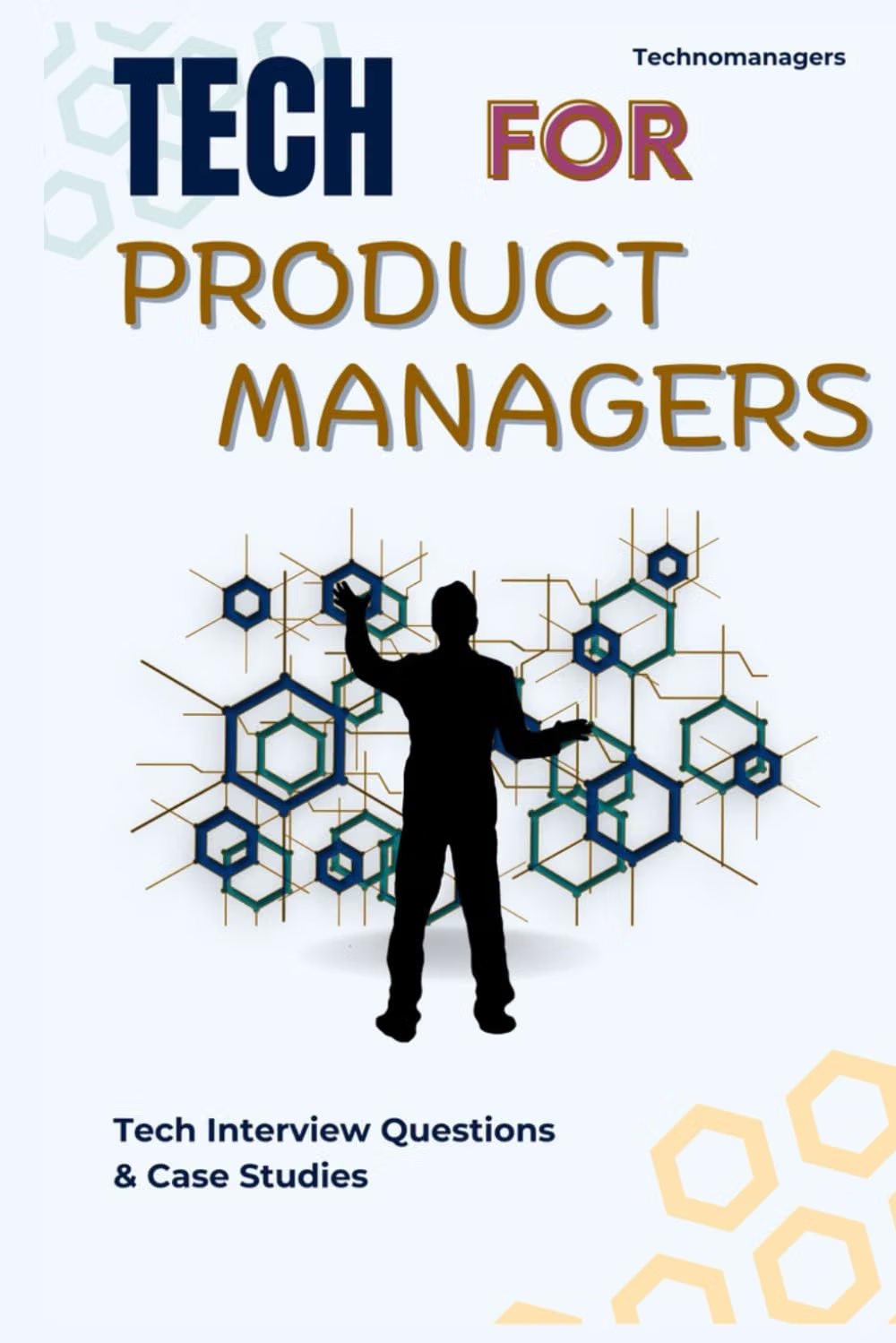
Tech for Product Managers: Tech Case Studies & Concepts Explained by Shailesh Sharma is a technology-focused guide intended to help product managers develop that technical foundation. The book was independently published in 2025 and is listed under ISBN-13 9798305851793. Available bibliographic information describes it as a 130-page English-language paperback.
The central idea behind the book is straightforward: product managers benefit from understanding the technology behind the products they help define. Instead of treating engineering concepts as a separate discipline, the book connects technical subjects with product development and decision-making.
Its scope is relatively broad. The listed subjects include software development life cycles, technology fundamentals, mobile and web applications, databases, application architecture, web technologies, APIs, system design, cloud computing, A/B testing, machine learning, artificial intelligence, augmented and virtual reality, big data, and the Internet of Things.
That range makes the book potentially useful as a bridge between product strategy and technical implementation. A product manager can encounter all of these areas during a career, even when their role does not require them to become a specialist in every technology.
The book is also built around case-study-oriented learning. Shailesh Sharma has published product-management material using practical scenarios, including case studies involving products and technology companies.
For readers considering this book, however, it is helpful to set realistic expectations. A concise product-management technology guide is not a replacement for a computer science degree, engineering documentation, or specialized courses in areas such as distributed systems or machine learning. Its role is better understood as an accessible foundation that helps product professionals develop technical vocabulary and reasoning skills.
What Is Tech for Product Managers?
Tech for Product Managers: Tech Case Studies & Concepts Explained is a technology and product-management book written by Shailesh Sharma. It was published independently in 2025. The available edition information identifies the book as a paperback with ISBN-13 9798305851793.
The book focuses on explaining technical concepts from the perspective of product management. Its stated subjects cover both foundational technology and more advanced areas.
Among the topics identified in published descriptions are:
- Software Development Lifecycle
- Technology fundamentals
- Mobile and web application basics
- Databases
- Application architecture
- HTTP and REST APIs
- Front-end development
- System design
- Consistent hashing
- CAP theorem
- Load balancing
- Caching
- SQL and NoSQL databases
- Data partitioning
- Cloud computing
- A/B testing
- Machine learning
- Artificial intelligence
- Machine-learning algorithms
- Augmented reality
- Virtual reality
- Big data
- Internet of Things
The breadth of this list illustrates an important point about modern product management. Technical knowledge is not limited to understanding how software is coded. Product decisions can involve infrastructure, data storage, experimentation, scalability, cloud services, artificial intelligence, and connected devices.
A product manager who understands the basic principles behind these technologies can ask more informed questions and participate more effectively in technical discussions.
Key Features and Learning Areas
Understanding Why Technology Matters to Product Management
One of the book’s fundamental themes is the connection between technology and product decisions.
Product managers frequently need to balance competing requirements. A feature might be valuable to customers but technically expensive. Another feature might be simple to implement but have limited impact. A third option could provide significant long-term value while requiring architectural changes.
Without some technical understanding, it can be difficult to understand why engineering teams recommend one approach over another.
Technical knowledge does not mean that a product manager needs to dictate implementation details. Instead, it can help the product manager understand constraints, identify tradeoffs, and ask useful questions.
For example, knowing the difference between a database query and an API request can make a technical conversation much easier to follow. Understanding caching can help explain why users may sometimes see older information. Understanding scalability can clarify why a solution that works for 10,000 users may require a different architecture at 10 million users.
These concepts become part of the product manager’s decision-making vocabulary.
Software Development Lifecycle
The Software Development Lifecycle, or SDLC, provides a framework for understanding how software moves from an idea toward a working product and ongoing maintenance.
For a product manager, the SDLC can provide useful context around requirements, design, development, testing, deployment, monitoring, and iteration.
Understanding these stages can improve planning. A feature that looks simple from a customer perspective may involve multiple engineering tasks, testing requirements, database changes, security considerations, or deployment dependencies.
The product manager does not necessarily perform these technical tasks, but understanding where they fit can make project planning more realistic.
Technology Fundamentals
Technology terminology can sometimes become a barrier between product and engineering teams.
Terms such as server, client, database, API, framework, cloud, backend, frontend, and infrastructure appear regularly in technology organizations.
A product manager who understands the basic meaning of these terms can participate in technical conversations without needing to become a software engineer.
This is particularly relevant for aspiring product managers who come from business, marketing, finance, design, or other non-engineering backgrounds.
Mobile and Web Applications
Modern products often operate across multiple environments.
A website might have a frontend that runs in a browser and a backend that processes requests. A mobile application may communicate with remote services through APIs while storing some information locally on a phone.
Understanding these components can help a product manager think more clearly about product requirements.
For example, a request such as “users should be able to continue using the app when they temporarily lose internet access” is not simply a user-interface requirement. It can involve local data storage, synchronization, conflict resolution, and backend behavior.
A technical foundation helps the product manager recognize these implications earlier.
Databases
Databases are fundamental to many digital products.
The book introduces database concepts and discusses different approaches to storing and managing information. Its listed topics include SQL and NoSQL databases.
For product managers, database knowledge can be useful when thinking about:
- Customer profiles
- Orders
- Transactions
- Search
- Product catalogs
- Analytics
- Content
- Relationships between records
- Data consistency
- Performance
A product manager does not need to design database schemas personally in every situation, but understanding why different database technologies exist can help when discussing product requirements.
Application Architecture
Application architecture describes how the major components of a software system are organized and communicate.
Architecture decisions can affect performance, scalability, reliability, development speed, and operational complexity.
For product managers, the key lesson is not memorizing every architectural pattern. It is understanding that technical architecture creates product-level consequences.
A product requirement may influence architecture, while architectural limitations may influence which product requirements are practical.
This creates a two-way relationship between product strategy and engineering.
Web Technologies and APIs
HTTP and REST APIs are specifically identified among the subjects covered by the book.
An API can be thought of as a structured way for software components to communicate.
For example, a mobile application might request account information from a backend service through an API. The backend processes the request and returns information that the application can display.
Understanding this basic flow can help product managers reason about integrations and dependencies.
If a product needs to connect with a payment provider, mapping service, authentication system, analytics platform, or another external service, APIs may become part of the implementation.
System Design
System design is one of the more technical subjects listed in the book.
The described topics include consistent hashing, the CAP theorem, load balancing, caching, SQL versus NoSQL, and data partitioning.
These concepts are particularly relevant when products grow.
A small application may work adequately with a simple architecture. As traffic, users, data volume, and geographic distribution increase, engineering teams may need more sophisticated approaches.
A product manager does not need to implement consistent hashing or configure load balancers, but understanding why such technologies exist can provide valuable context when discussing scalability.
Cloud Computing
Cloud computing has become an important part of modern software development.
Cloud platforms can provide computing resources, storage, databases, networking, monitoring, and other services without requiring an organization to operate every physical component itself.
For product managers, cloud concepts can help explain questions surrounding scalability, deployment, infrastructure costs, reliability, and geographic availability.
Cloud architecture can also affect product strategy. For example, supporting users in multiple regions may introduce requirements involving latency, data residency, redundancy, and regional infrastructure.
A/B Testing
Product decisions often involve uncertainty.
An A/B test provides one way to compare different versions of a product experience using measured outcomes.
The book includes A/B testing among its technology and product-development topics.
For product managers, understanding experimentation means more than knowing how to create two versions of a button.
A useful experiment requires a clear hypothesis, an appropriate metric, a defined population, and a reasonable interpretation of the results.
Poorly designed experiments can produce misleading conclusions. Factors such as sample size, selection bias, experiment duration, seasonality, and statistical uncertainty can affect interpretation.
A technical foundation therefore supports better product experimentation.
Machine Learning and Artificial Intelligence
Machine learning and artificial intelligence are among the more contemporary topics covered by the book.
The published description indicates that the book introduces machine-learning concepts, popular algorithms, and case studies involving machine learning.
For product managers, AI knowledge can be useful because machine-learning systems differ from traditional software in important ways.
A traditional feature might produce predictable output from explicitly programmed rules. A machine-learning system may generate predictions based on patterns learned from data.
That introduces additional product questions:
- What data is available?
- How reliable is the data?
- What does the model predict?
- How will accuracy be measured?
- What happens when the model is wrong?
- How frequently should it be updated?
- What risks arise from biased or incomplete data?
- How should users understand automated decisions?
These questions connect technology directly to product design.
Augmented and Virtual Reality
AR and VR are also included among the book’s listed topics.
These technologies introduce different interaction models from traditional websites and mobile applications.
Augmented reality can place digital information within a user’s physical environment, while virtual reality can create an immersive digital environment.
From a product-management perspective, the technology should not be viewed independently from the user problem. The important question is not simply whether AR or VR can be implemented, but whether the technology creates a meaningful experience for the intended audience.
Big Data
As products generate larger quantities of information, data infrastructure becomes increasingly important.
Big-data concepts can involve storage, processing, analytics, distributed systems, and the ability to extract useful information from large datasets.
For product managers, this can affect analytics strategy, personalization, recommendation systems, reporting, and operational decision-making.
The book’s inclusion of big data alongside machine learning and system design reflects how closely these areas can intersect in modern products.
Internet of Things
The Internet of Things connects physical devices to digital systems.
Examples include connected appliances, sensors, wearable devices, industrial equipment, and smart-home products.
IoT products can create additional product-management challenges because they combine hardware, software, connectivity, data, and sometimes cloud infrastructure.
A product manager working on an IoT product may need to consider device reliability, connectivity interruptions, firmware updates, data security, physical environments, and user installation.
Understanding these concepts can help bridge the gap between a physical product and its associated digital services.
How the Book Can Be Used
As a Technical Foundation for Aspiring Product Managers
Someone preparing for a product-management career may encounter technical vocabulary during interviews, case studies, or conversations with engineering teams.
A structured introduction can help reduce that learning gap.
Instead of studying isolated definitions, readers can use the book’s range of topics to build a broad map of the technology landscape.
As a Reference During Product Work
Product managers frequently encounter unfamiliar technical concepts.
A project might involve an API one month, database architecture the next, and machine-learning experimentation later.
A broad reference can help a product manager understand the terminology before having a deeper conversation with technical specialists.
As Interview Preparation
Technical product-management interviews can involve questions about system design, architecture, experimentation, data, and technology tradeoffs.
The book’s combination of concepts and case-study-oriented material can be relevant to this preparation.
Shailesh Sharma has also published product-management interview material and case-study discussions, including examples involving product design scenarios.
A reader should still supplement any book with current interview expectations and hands-on practice.
As a Bridge Between Business and Engineering
One of the most useful applications of technical knowledge is communication.
A product manager often has to translate customer and business requirements into language that engineering teams can act upon, while also explaining technical constraints to nontechnical stakeholders.
Knowing the underlying concepts can make that translation more precise.
As a Starting Point for Deeper Study
A broad introductory book can also help identify areas worth studying in greater depth.
A reader might discover an interest in:
- Distributed systems
- Cloud architecture
- Machine learning
- Data engineering
- APIs
- Databases
- Mobile development
- Artificial intelligence
- IoT
The book can therefore serve as a map of the technical landscape rather than an exhaustive course in every topic.
Who It May Be Suitable For
Aspiring Product Managers
People preparing for their first product-management role may find the technical vocabulary useful, particularly if they do not have a computer science background.
Current Product Managers
Experienced product managers can also encounter technical areas outside their previous experience. A broad reference can help fill knowledge gaps.
Associate Product Managers
APMs often work closely with engineers and designers while learning product-development processes. Technical fundamentals can help them participate more confidently in those conversations.
Business and Strategy Professionals
People transitioning from business strategy, consulting, operations, marketing, or finance into technology product management may benefit from a technology primer.
Founders and Entrepreneurs
Startup founders frequently make product decisions without having large specialized teams. Understanding the basics of APIs, architecture, databases, cloud infrastructure, and experimentation can help founders communicate with developers and evaluate technical proposals.
Designers Interested in Product Development
Product designers increasingly work in cross-functional teams. Understanding technical constraints can help designers anticipate implementation considerations and communicate more effectively with engineering.
Important Things to Consider
It Is a Broad Introduction, Not a Complete Computer Science Course
The book covers many subjects, but breadth and depth are different things.
A short book covering databases, system design, cloud computing, machine learning, AI, AR/VR, big data, and IoT cannot provide the same depth as specialized technical textbooks or university courses in each discipline.
Readers should approach it as a foundation.
Technical Knowledge Does Not Replace Engineering Expertise
A product manager’s technical literacy should support collaboration rather than replace specialized engineering judgment.
Understanding what a load balancer does is different from being able to design and operate a production-scale distributed system.
The distinction is important when translating technical knowledge into professional responsibilities.
Technology Changes Quickly
Technology evolves rapidly, particularly in areas such as artificial intelligence, cloud platforms, developer tools, and application architecture.
A book published in 2025 provides a snapshot of its publication period. Current technologies, terminology, and practices may continue to change.
Readers working on active products should verify implementation details using current technical documentation.
Case Studies Need Context
Case studies can be valuable because they show how abstract concepts relate to real products.
However, a case study necessarily simplifies reality.
Real product decisions may involve legal requirements, organizational politics, existing infrastructure, budgets, security constraints, customer contracts, and technical debt that are not fully represented in a simplified example.
Case studies should therefore be used to practice reasoning rather than copied as universal formulas.
Technical Decisions Have Product Consequences
A technical decision should not be evaluated solely from an engineering perspective.
For example, an architecture that increases reliability might also increase development or infrastructure complexity. A sophisticated machine-learning model might improve prediction quality but introduce operational and monitoring requirements.
Product managers need to understand these tradeoffs in the context of customer and business goals.
Comparing General Categories of Product-Management Learning Resources
Technology Primer vs. Computer Science Textbook
A technology primer is designed to provide breadth and practical context.
A computer science textbook generally explores concepts more deeply and systematically.
For a product manager who needs working knowledge across many technology areas, breadth may be useful. Someone preparing for an engineering career would typically need considerably deeper technical study.
Case-Study Book vs. Theory-Focused Resource
Case studies can make abstract concepts easier to connect to practical product decisions.
Theory-focused resources may provide more detailed explanations of the underlying mathematics, algorithms, or engineering principles.
The two approaches can complement one another.
Product Management Book vs. Engineering Book
A conventional product-management book may focus heavily on discovery, prioritization, roadmaps, metrics, customer research, and stakeholder management.
An engineering book may focus on implementation, architecture, algorithms, or infrastructure.
A technology guide for product managers sits between these categories. Its purpose is to help product professionals understand the technical environment in which their decisions are implemented.
Broad Guide vs. Specialized Course
A broad book can introduce many areas quickly.
A specialized course can spend substantially more time on a particular subject, often including exercises and projects.
Someone who discovers a strong interest in system design or machine learning may therefore use an introductory guide as the starting point before moving to more specialized material.
Practical Ways to Apply the Concepts
Reading technical material becomes more useful when connected to actual product scenarios.
Consider an imaginary shopping application. A product manager could use the book’s concepts to ask how product searches are processed, where customer information is stored, how APIs connect the mobile application to backend services, and what happens when traffic increases.
Consider an online learning platform. The product manager might need to think about video delivery, user accounts, analytics, experimentation, and cloud infrastructure.
Consider a smart-home product. IoT concepts become relevant because the physical device must communicate with software services while dealing with connectivity, updates, data, and security.
Consider an AI-powered recommendation feature. Machine learning, data quality, experimentation, model performance, and user experience all become connected product considerations.
These scenarios demonstrate why technical knowledge can be valuable even when a product manager is not responsible for writing the underlying code.
Frequently Asked Questions
Who wrote Tech for Product Managers: Tech Case Studies & Concepts Explained?
The book was written by Shailesh Sharma. Bibliographic listings identify the author as Shailesh Sharma and the publisher as Independently published.
When was the book published?
Available bibliographic information identifies 2025 as the publication year.
What is the ISBN?
The paperback edition is listed with ISBN-13 9798305851793.
How long is the book?
The available book listing describes a 130-page edition.
Is this book only for experienced product managers?
No. The described audience includes aspiring and current product managers, as well as people interested in understanding the technology landscape behind modern products.
Does the book explain databases?
Yes. Database concepts are among the listed subjects, including different database approaches and SQL versus NoSQL.
Does it cover APIs?
Yes. The book includes web-technology concepts such as HTTP and REST APIs.
Does it discuss system design?
Yes. The listed system-design topics include consistent hashing, the CAP theorem, load balancing, caching, SQL versus NoSQL, and data partitioning.
Does the book cover artificial intelligence?
Yes. Artificial intelligence and machine learning are among the technology areas included in the book.
Does it include machine-learning case studies?
The published description states that the book covers popular machine-learning algorithms and includes machine-learning case studies.
Does it cover cloud computing?
Yes. Cloud computing is specifically included among the book’s technology topics.
Does it discuss A/B testing?
Yes. A/B testing is listed as one of the subjects covered.
Does the book cover AR and VR?
Yes. Augmented reality and virtual reality are included in the published description of the book’s topics.
Does it discuss Internet of Things technology?
Yes. IoT is included among the technologies discussed.
Is this book useful for someone without a computer science degree?
The book is specifically positioned toward product managers and aspiring product managers who want to strengthen their technical understanding. That makes it relevant to readers whose primary background is not computer science.
However, readers should distinguish between learning technical concepts and acquiring professional engineering expertise.
Can the book replace technical training?
It is better viewed as a foundation or reference rather than a complete substitute for specialized technical education. Its broad scope covers many areas, while individual subjects such as distributed systems, databases, cloud architecture, or machine learning can require much deeper study.
How can product managers benefit from technical knowledge?
Technical knowledge can help product managers understand implementation constraints, communicate with engineers, evaluate tradeoffs, ask more precise questions, and connect technical decisions with customer and business requirements.
Does technical knowledge mean a product manager needs to become a programmer?
Not necessarily. Product management and software engineering are different disciplines. A product manager can benefit substantially from understanding technical concepts without becoming responsible for implementing every technical component.
Conclusion
Tech for Product Managers: Tech Case Studies & Concepts Explained approaches technology from a product-management perspective, with the goal of helping readers understand the technical systems behind modern digital products.
Written by Shailesh Sharma and independently published in 2025, the book covers a wide range of subjects, including software development, applications, databases, architecture, APIs, system design, cloud computing, experimentation, machine learning, artificial intelligence, AR/VR, big data, and IoT.
Its broad coverage makes the book particularly relevant to readers who need technical literacy rather than deep specialization in a single engineering discipline. For aspiring product managers, it can provide vocabulary and context. For current product managers, it can serve as a reference when unfamiliar technical subjects arise. For professionals moving from business-oriented roles into technology, it can help make engineering conversations easier to understand.
The most useful way to approach technical knowledge in product management is not as an attempt to replace engineers. Instead, it is a way to improve collaboration and decision-making. A product manager who understands APIs, databases, architecture, experimentation, cloud infrastructure, and AI concepts can better recognize how technical choices affect customers and business objectives.
At the same time, readers should keep the book’s scope in perspective. Its broad coverage means individual technical subjects cannot be explored with the same depth as dedicated engineering textbooks or specialized courses. Technology also changes quickly, so current documentation and contemporary technical resources remain important when making implementation decisions.
For anyone looking to build a stronger bridge between product strategy and technology, the book provides a structured collection of concepts and case-study-oriented material to explore.
Leave a Reply