Author: admin

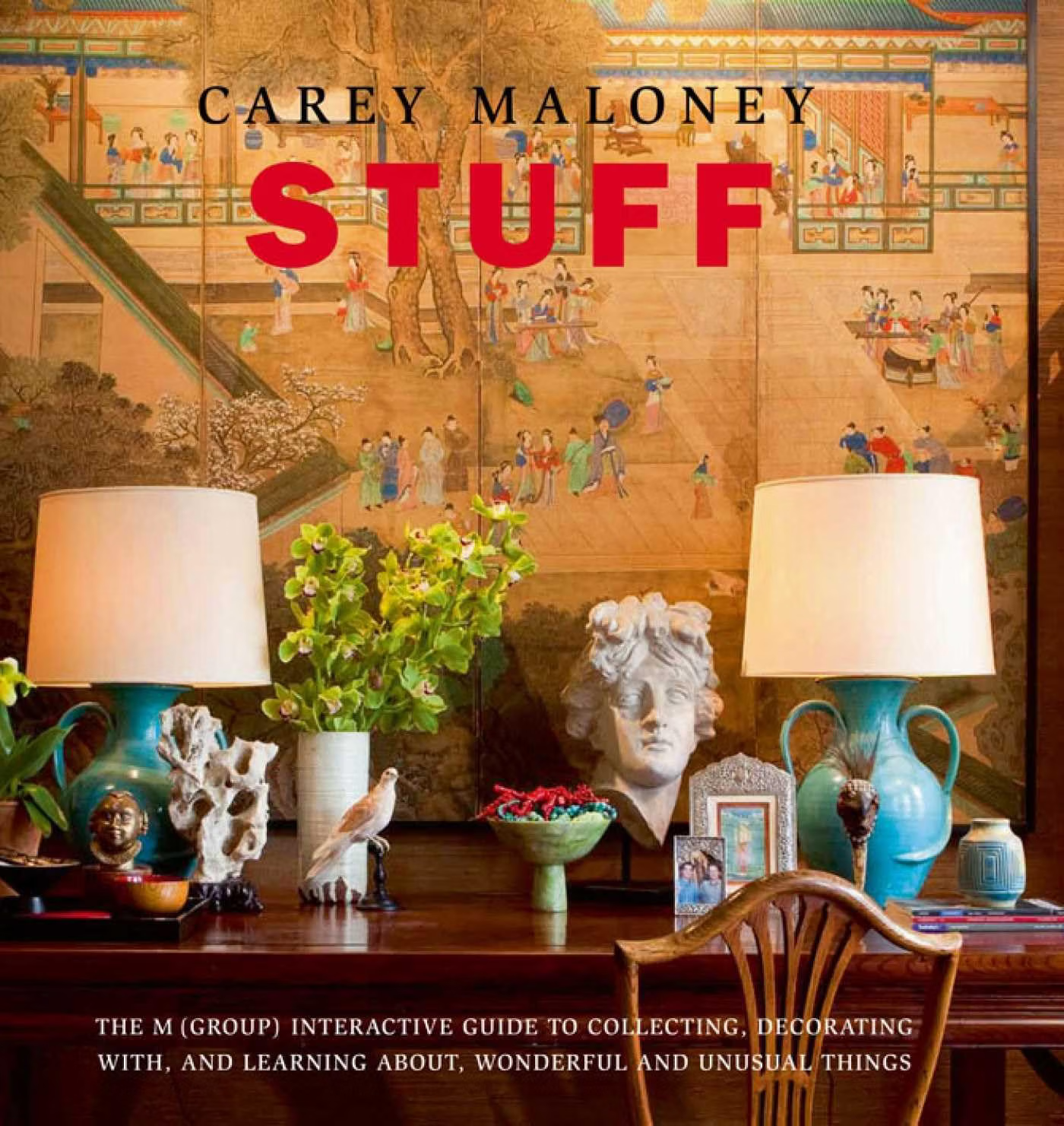
  • Stuff: The M(Group) Interactive Guide to Collecting, Decorating With, and Learning About Wonderful and Unusual Things

    Stuff: The M(Group) Interactive Guide to Collecting, Decorating With, and Learning About Wonderful and Unusual Things

    Introduction

    A home can be understood in many different ways. It can be a place to live, a reflection of personal taste, a collection of memories, or an evolving display of interests. Furniture and architecture provide the structure, but smaller objects often give an interior its personality. A lamp, painting, antique, scientific model, piece of pottery, textile, sculpture, or unusual decorative object can introduce history and character into an otherwise ordinary room.

    Stuff: The M(Group) Interactive Guide to Collecting, Decorating With, and Learning About, Wonderful and Unusual Things explores this relationship between collecting, interior design, art, and curiosity. Written by Carey Maloney, the book examines the objects and collections that contribute to the interiors created by M(Group), the architecture and interior-design firm founded by Maloney and architect Hermes Mallea. The firm was established in 1984 and has worked across architecture and interior design.

    The book was published by Pointed Leaf Press and distributed by Simon & Schuster. The edition associated with ISBN-10 0983388989 and ISBN-13 9780983388982 is a hardcover publication from 2012/2013 depending on the cataloging source, with approximately 218–224 pages and hundreds of color photographs.

    What makes Stuff particularly distinctive is its combination of interior photography, collecting ideas, historical information, and an interactive component. The publisher describes a digital-recognition system that allows readers to explore additional information connected to approximately 40 topics, including links to museums, dealers, shops, and research resources.

    The subject matter is intentionally wide-ranging. Rather than limiting itself to conventional furniture or familiar decorative categories, the book explores objects and collections such as anatomical models, Australian Aboriginal art, pre-Columbian pottery, Coromandel screens, taxidermy, Tiffany lamps, and many other unusual subjects.

    For readers interested in interior design, antiques, art collecting, decorative objects, architecture, or the history behind everyday things, this creates a different kind of design resource. It encourages the reader to look at interiors not simply as arrangements of furniture, but as environments shaped by curiosity, collecting, cultural references, personal history, and visual relationships.

    Because the book was published more than a decade ago, its interactive technology should also be considered in its historical context. Digital recognition systems and linked online resources can change as apps, websites, operating systems, and online destinations evolve. The printed photography and design concepts, however, remain independent of those technological changes.

    What Is Stuff: The M(Group) Interactive Guide?

    Stuff is a large-format interior-design and collecting book by Carey Maloney. It focuses on the interiors created by M(Group), the design firm founded by Maloney and Hermes Mallea, while also exploring the objects that give those spaces their individual character.

    The publisher describes the book as an interactive omnibus that takes readers into the homes of passionate collectors and examines the wide range of art, furniture, and objects used in M(Group)’s interiors.

    Rather than presenting collecting as a purely financial activity, the book approaches objects through design, history, curiosity, and personal expression.

    That distinction is important.

    A collection does not necessarily have to consist of rare or expensive objects. Someone might collect ceramics, maps, vintage advertisements, scientific instruments, botanical prints, books, textiles, lamps, toys, or objects associated with a particular profession or period.

    The book’s subject matter demonstrates how unusual objects can become part of an interior when they are placed thoughtfully.

    The result is a combination of:

    • Interior-design photography
    • Collecting inspiration
    • Art and decorative-object history
    • Architectural context
    • Cultural references
    • Personal anecdotes
    • Research resources
    • Interactive digital material

    The publisher identifies the book as a hardcover measuring approximately 11 by 12 inches, with 218 pages, while other bibliographic sources list 224 pages.

    Key Features

    A Focus on Collecting

    Collecting is at the center of the book.

    Rather than treating decorative objects as interchangeable accessories, Stuff explores how objects can carry meaning. A collection can reflect a person’s professional interests, travel experiences, historical curiosity, artistic preferences, or simply an attraction to unusual forms.

    This creates an important connection between collecting and interior design.

    A room does not have to be decorated exclusively with objects purchased at the same time or from the same design period. Different pieces can coexist when there is a meaningful relationship between them.

    For example, an antique object might sit alongside contemporary furniture. A scientific model could become a visual counterpoint to traditional artwork. A collection of ceramics could introduce color and texture into a room with relatively simple architectural lines.

    The book provides examples of this layered approach through the interiors and collections associated with M(Group).

    Unusual and Unexpected Objects

    The title’s emphasis on “wonderful and unusual things” is reflected in the subjects selected.

    The book explores objects ranging from anatomical models to taxidermy and from pre-Columbian pottery to Tiffany lamps.

    This range encourages readers to reconsider what qualifies as a decorative object.

    Interior design is often associated with familiar categories such as sofas, tables, curtains, rugs, lighting, and artwork. Those elements remain important, but unusual objects can introduce another layer.

    An object with an interesting history can become a conversation point. An unusual shape can provide visual contrast. A group of related objects can create rhythm across a room.

    The underlying idea is that decoration can emerge from curiosity rather than from following a predetermined shopping list.

    Interior Photography

    The visual component is an important part of the book.

    The publisher and booksellers describe the book as a large-format hardcover with extensive color photography. One bookseller specifies approximately 300 color photographs.

    Photography allows readers to examine how objects function in actual interiors rather than seeing them only as isolated catalog items.

    This distinction matters because an object can look very different depending on its surroundings.

    A lamp may become a focal point against a plain wall. A collection of small objects may work better when grouped together than when distributed throughout a room. A large piece of artwork may need sufficient surrounding space to remain visually effective.

    Photographs can communicate these relationships more effectively than a simple list of decorating rules.

    The M(Group) Design Approach

    The book is closely connected to M(Group), the design firm established by Carey Maloney and Hermes Mallea in 1984. The firm describes its work as architecture and interior design, with an international publication history.

    The firm’s work provides the visual setting in which the objects are presented.

    This makes the book different from a conventional antiques encyclopedia. It is not simply a catalog of objects with historical descriptions. Instead, objects are considered as components of designed spaces.

    This approach can help readers think about scale, proportion, placement, contrast, repetition, color, and visual balance.

    Interactive Digital Component

    One of the more unusual aspects of the publication is its interactive component.

    The publisher describes digital recognition technology that allows readers to access additional information associated with approximately 40 topics. The system was designed to connect readers with museums, dealers, shops, and research resources beyond the printed book.

    This concept was particularly distinctive when the book was published.

    The idea was to make the printed page a starting point rather than an endpoint. A reader could encounter an object or topic in the book and then explore related material digitally.

    Because the book dates from the early 2010s, however, readers should not assume that every original digital link, app, or interactive feature remains functional today.

    The printed content remains the more durable part of the experience.

    Personal Anecdotes

    The publisher describes the book as containing personal anecdotes from Carey Maloney alongside the visual and informational material.

    Anecdotes can provide another way of understanding collecting.

    Objects are not always selected through a purely analytical process. People often become interested in something because of where they encountered it, what it reminds them of, its unusual appearance, or the story associated with it.

    These personal connections can become part of an interior’s identity.

    Collecting as Part of Interior Design

    Objects Can Tell Stories

    One of the most useful ideas to take from a collecting-focused design book is that objects can communicate information.

    A room containing carefully selected objects can tell visitors something about its occupants.

    A collection of travel maps may suggest an interest in geography and exploration. Old scientific instruments may indicate fascination with science. Artifacts from different historical periods can create a visual conversation between cultures and eras.

    This does not mean every object needs a profound story.

    Sometimes the attraction is simply visual.

    The important point is that personal objects can make a space feel connected to its occupants rather than assembled from a generic catalog.

    Collections Create Relationships

    A single object may be interesting, but several related objects can create a stronger visual statement.

    Collections introduce repetition.

    Repeated forms, colors, materials, periods, or themes can create cohesion even when individual objects differ.

    For example, a group of ceramic vessels might vary in shape while sharing a material. A collection of maps might differ geographically while sharing a particular printing style. A series of lamps could vary in design while creating a recurring visual element.

    This is one reason collections can become effective interior-design tools.

    Mixing Periods and Styles

    Traditional decorating often emphasizes consistency.

    A room might be described as modern, traditional, industrial, minimalist, or eclectic.

    In practice, many interesting interiors combine elements from multiple periods.

    An antique chair can sit beside a contemporary table. Modern architecture can provide a setting for historical objects. A traditional painting can be displayed in a room with contemporary lighting.

    The challenge is not necessarily to make everything match.

    Instead, the designer can look for relationships in scale, color, material, shape, or visual rhythm.

    The M(Group) approach presented through Stuff provides examples of interiors in which diverse objects contribute to a layered environment.

    How It Can Be Used

    As Interior-Design Inspiration

    The most immediate use of Stuff is as a source of visual inspiration.

    Readers can study photographs to see how furniture, art, architectural elements, and collections interact.

    Rather than copying a room exactly, a reader can identify individual ideas that might translate to a different home.

    For example:

    • Grouping similar objects
    • Using unusual objects as focal points
    • Combining old and new pieces
    • Creating visual contrast
    • Using collections to fill architectural spaces
    • Allowing objects to reflect personal interests
    • Mixing materials and textures

    The goal can be inspiration rather than imitation.

    As a Starting Point for Collecting

    Someone who has never collected decorative objects may not know where to begin.

    A broad exploration of unusual objects can help identify subjects that genuinely interest the reader.

    The process can begin with a question:

    What kind of object would I enjoy learning about even if I never purchased it?

    That question shifts collecting away from acquisition alone and toward curiosity.

    Someone may discover an interest in vintage scientific equipment, antique maps, ceramics, botanical illustrations, lamps, textiles, or historical furniture.

    Once an interest is identified, the collector can research the history, makers, materials, provenance, and preservation requirements associated with the category.

    As a Research Companion

    The book’s interactive concept was designed partly to connect readers with museums, dealers, and research resources.

    This makes research an important part of the experience.

    For valuable or historically significant objects, research can include:

    • Identifying the maker
    • Establishing approximate age
    • Understanding materials
    • Investigating provenance
    • Comparing similar examples
    • Consulting museum collections
    • Reading specialist references
    • Learning conservation requirements

    Research can make collecting more meaningful even when no purchase is involved.

    As a Coffee-Table Reference

    The large format and extensive photography also make the book suitable for browsing.

    A reader can open it without having a specific design problem to solve and simply explore the photographs, objects, and subjects.

    This type of browsing can be valuable because design ideas often emerge indirectly.

    A photograph may suggest a color combination. An unusual object may inspire a collecting idea. A particular arrangement may change how someone thinks about displaying books, artwork, or decorative pieces.

    Who It May Be Suitable For

    Interior Design Enthusiasts

    Readers interested in residential interiors can explore how collections and unusual objects influence the character of a room.

    Collectors

    Collectors may appreciate the wide range of categories presented in the book and the emphasis on learning about objects rather than simply acquiring them.

    Antiques Enthusiasts

    The historical and object-focused approach can be relevant to people who enjoy antiques, decorative arts, and objects with cultural or historical associations.

    Architecture Readers

    Because M(Group)’s architecture and interior-design work provides the context for the book, architecture enthusiasts may find the relationship between structure and decoration interesting.

    Art Lovers

    The book includes art and decorative objects alongside furniture and architecture, making it relevant to readers interested in visual culture more broadly.

    Students of Interior Design

    Students can use the photographs as examples for thinking about composition, proportion, scale, layering, and the relationship between objects and rooms.

    Curious Readers

    The book is not limited to professional designers. Someone who enjoys learning about unusual historical objects may find its range of subjects appealing.

    Important Things to Consider

    It Is an Older Publication

    The book dates from 2012/2013 depending on the edition or cataloging source. The publisher currently identifies the ISBN as 978-0-983388-98-2, while the Amazon-linked ISBN-10 is 0983388989.

    The design photography and printed research remain useful, but some references may reflect the collecting and design landscape of the period when the book was produced.

    The Interactive Technology May Have Limitations Today

    The digital-recognition component was designed to connect physical pages with online information.

    Modern readers should keep in mind that websites, mobile applications, domains, and digital services can change or disappear.

    The interactive feature should therefore be viewed as an additional component rather than the sole reason to use the book.

    Collecting Requires Research

    An attractive object is not necessarily a valuable object.

    The book can inspire curiosity, but readers interested in purchasing antiques or collectibles should conduct independent research.

    Factors such as authenticity, condition, provenance, restoration, rarity, maker, cultural origin, and market demand can all affect an object’s significance.

    Cultural Objects Require Context

    Some categories discussed in the book involve objects originating from particular cultures or historical periods.

    Collectors should approach such objects with appropriate attention to cultural context, provenance, legal restrictions, ethical considerations, and responsible sourcing.

    This is especially relevant when dealing with archaeological artifacts, Indigenous cultural material, wildlife-related objects, or objects whose export or sale may be regulated.

    Decorative Choices Are Personal

    The interiors presented in the book reflect a particular design philosophy and the work of M(Group).

    Readers do not need to reproduce that aesthetic exactly.

    A useful design reference should provide ideas rather than dictate a single definition of good taste.

    Comparison of General Categories

    Interior-Design Book vs. Collecting Guide

    A conventional interior-design book may focus primarily on rooms, furniture arrangements, color schemes, materials, and architectural elements.

    A collecting guide tends to focus more heavily on individual objects, their history, identification, and acquisition.

    Stuff occupies a middle ground.

    It examines collections while showing how those objects function within complete interiors.

    Coffee-Table Book vs. Practical Design Manual

    A practical design manual usually provides structured instructions.

    A large-format illustrated book may instead emphasize visual examples, inspiration, and exploration.

    Stuff fits strongly into the latter category while still providing informational context around the objects it presents.

    Museum Catalog vs. Decorative-Arts Book

    A museum catalog generally focuses on institutional collections and scholarly documentation.

    A decorative-arts book may be more concerned with how objects exist in private environments.

    Stuff takes the latter approach by placing objects within homes and designed interiors.

    Historical Reference vs. Current Buying Guide

    The book can help readers understand objects and develop collecting interests.

    It should not be treated as a current price guide or definitive source for contemporary market values.

    Collectors should use current specialist resources when researching present-day prices, authenticity, market conditions, or legal requirements.

    Building a Personal Collection

    A collection does not need to begin with a large budget or a fully developed theme.

    A useful starting point is observation.

    Visit museums, galleries, antique stores, flea markets, design exhibitions, architectural spaces, and online archives. Pay attention to which objects repeatedly capture your attention.

    Then begin researching.

    Ask:

    • What is this object?
    • Who made it?
    • When was it made?
    • What was it originally used for?
    • What materials were used?
    • Where did it originate?
    • How common is it?
    • What condition should it be in?
    • How should it be displayed?
    • Does it require special conservation?

    This process can transform collecting into an educational activity.

    Choosing a Theme

    Some collections develop around a clear theme.

    Possible themes might include:

    • A particular material
    • A historical period
    • A geographic region
    • A profession
    • A design movement
    • A color
    • A type of object
    • A maker
    • A particular function

    A theme can make it easier to decide what belongs in a collection and what does not.

    However, not every collection needs strict boundaries.

    Some collectors simply follow curiosity.

    Displaying Objects

    Collecting and displaying are separate decisions.

    An object may be valuable to the collector but not necessarily need to be displayed prominently.

    When arranging objects, consider:

    Scale: Large pieces need appropriate surroundings.

    Spacing: Objects need enough visual room to remain distinguishable.

    Grouping: Related pieces can create a stronger composition.

    Lighting: Lighting can influence how materials, colors, and textures appear.

    Safety: Fragile or valuable objects may require secure placement.

    Context: The surrounding furniture and architecture affect how the object is perceived.

    These principles apply whether the objects are valuable antiques or inexpensive personal finds.

    Learning From Unusual Objects

    One of the broader ideas behind Stuff is that objects can become gateways into other subjects.

    A lamp can lead to an exploration of industrial design.

    A map can introduce geography and printing history.

    A ceramic vessel can lead to archaeology, craftsmanship, or cultural history.

    An anatomical model can introduce medical education and scientific illustration.

    A piece of furniture can lead to architecture, materials, manufacturing, and social history.

    This is one reason collecting can be an intellectual activity as well as a decorative one.

    The object becomes a starting point for research.

    Using the Book for Interior Design Projects

    A reader working on a room can use the book as a visual reference without copying its interiors directly.

    Start with the architecture.

    What are the room’s proportions, windows, doors, ceiling height, and natural-light conditions?

    Then consider the major furniture.

    After that, identify spaces where objects could provide personality.

    Instead of filling every surface, select a few meaningful categories.

    A small collection can be concentrated in one area, while a larger object can act as a focal point elsewhere.

    This approach can help avoid an interior that feels either completely empty or visually overloaded.

    The examples in Stuff demonstrate how collections can be incorporated into rooms as part of a broader design composition.

    Frequently Asked Questions

    Who wrote Stuff: The M(Group) Interactive Guide?

    The book was written by Carey Maloney, founder of M(Group) with architect Hermes Mallea.

    What is the ISBN of the book?

    The edition is associated with ISBN-10 0983388989 and ISBN-13 9780983388982.

    Who published the book?

    The book was published by Pointed Leaf Press and distributed by Simon & Schuster.

    What kind of book is Stuff?

    It is a large-format illustrated book combining interior design, architecture, collecting, art, decorative objects, historical information, and personal anecdotes.

    How many pages does it have?

    Publisher information describes the hardcover as 218 pages, while other bibliographic and retail sources list 224 pages.

    Is Stuff a book about interior design?

    Interior design is a major part of the book, but its scope is broader. It explores the relationship between interiors and collections of art, furniture, and unusual objects.

    What kinds of objects are discussed?

    The book covers a wide variety of subjects, including anatomical models, Australian Aboriginal art, pre-Columbian pottery, Coromandel screens, taxidermy, Tiffany lamps, and other unusual objects.

    Does the book include photographs?

    Yes. It is heavily illustrated with color photography. One bookseller describes approximately 300 color photographs.

    What is the interactive component?

    The book was designed with digital-recognition technology that could connect certain printed topics with additional online resources, including museums, dealers, shops, and research sources.

    Does the interactive feature still work today?

    The original digital system may not function exactly as it did when the book was published. Online services, websites, and applications can change over time.

    The printed book can still be used independently of those digital components.

    Is this a guide for professional collectors?

    It can provide inspiration and research ideas, but it should not be treated as a comprehensive professional appraisal, authentication, or valuation manual.

    Collectors dealing with significant purchases should conduct independent research and consult appropriate specialists.

    Is it useful for someone who is new to collecting?

    It can provide a broad introduction to different types of objects and demonstrate how collections can become part of an interior.

    A beginner can use the book to discover categories of objects that interest them before developing a more focused collecting strategy.

    Does the book provide current market prices?

    It is not a current price guide. Market values can change considerably, and contemporary valuation requires current specialist information.

    Is the book only for wealthy collectors?

    The concepts presented do not require someone to own rare or expensive objects. Collecting can involve inexpensive objects, found items, books, prints, ceramics, or other things connected to a person’s interests.

    Can the book help with decorating a home?

    It can provide visual inspiration for arranging collections, artwork, furniture, and unusual objects within interiors.

    Is the book suitable for interior-design students?

    It can serve as a visual reference for studying how objects interact with architecture, furniture, scale, color, and composition.

    Who is M(Group)?

    M(Group) is an architecture and interior-design firm founded by Carey Maloney and architect Hermes Mallea in 1984. The firm describes its work as architecture and interior design and has been published internationally.

    Is the book about antiques only?

    No. The subject matter extends beyond conventional antiques to art, furniture, scientific objects, cultural artifacts, decorative pieces, and unusual items.

    Can the book be used as a source for cultural research?

    It can serve as an introduction to various objects and subjects, but readers interested in detailed cultural, historical, archaeological, or anthropological research should consult specialist academic and institutional sources.

    Why might unusual objects be useful in interior design?

    Unusual objects can introduce contrast, conversation, historical context, visual interest, and personal character into a room.

    Their value in an interior does not necessarily depend on monetary value.

    Conclusion

    Stuff: The M(Group) Interactive Guide to Collecting, Decorating With, and Learning About, Wonderful and Unusual Things explores the relationship between objects, collections, architecture, and personal interiors.

    Written by Carey Maloney and published by Pointed Leaf Press, the book presents the work and collecting interests associated with M(Group), the architecture and interior-design firm Maloney founded with Hermes Mallea in 1984.

    Its appeal comes from the breadth of its subject matter. Instead of concentrating only on conventional furniture and decoration, the book moves into unusual territory, including anatomical models, Aboriginal art, pre-Columbian pottery, Coromandel screens, taxidermy, Tiffany lamps, and many other categories of objects.

    The book also demonstrates how collecting can become part of interior design. Objects can provide more than decoration: they can communicate interests, preserve memories, introduce historical context, create visual contrast, and give rooms a sense of individuality.

    The interactive component adds another dimension by connecting selected printed topics with digital research resources. Because the publication dates from the early 2010s, however, readers should treat the original digital system as a historical feature that may not function exactly as it did when first released.

    Perhaps the broader lesson is that decorating does not have to begin with a predetermined style. A home can develop through curiosity. A person can discover an object, research its history, appreciate its form, and eventually find a place for it within a larger environment.

    For readers interested in interior design, collecting, art, architecture, antiques, or unusual historical objects, Stuff provides a visual and informational exploration of how these subjects can overlap. It can be approached as a source of decorating ideas, a collecting reference, a large-format visual book, or simply an invitation to learn more about the objects that surround us.
    You can check more details on Amazon here.

  • Game Design: Konzepte, Kreation, Vermarktung — A Practical Guide to Game Development and the Games Business

    Game Design: Konzepte, Kreation, Vermarktung — A Practical Guide to Game Development and the Games Business

    Introduction

    Creating a successful video game involves considerably more than coming up with an interesting idea. A game has to be designed around rules, player interaction, goals, challenges, feedback, pacing, content, technology, production constraints, and a clearly defined audience. Behind the finished product is also a large business process involving development teams, publishers, testing, marketing, distribution, licensing, and sales.

    Game Design: Konzepte, Kreation, Vermarktung by Bob Bates approaches game development from this broader perspective. The German edition was published by SYBEX Verlag in 2002 and is associated with ISBN-10 3815504333 and ISBN-13 9783815504338. Bibliographic listings identify the edition as a German-language hardcover with 312 pages.

    The original English work is known as The Art & Business of Creating Games, a title that helps explain the scope of the book. Rather than concentrating exclusively on the mechanics of game design, it discusses the process of taking a game from an initial concept through development and toward the commercial marketplace.

    That distinction is useful for anyone interested in game development. A designer may understand gameplay systems but still need to work with producers, programmers, artists, testers, publishers, marketers, and other specialists. A technically impressive game can also face practical challenges if its scope is unrealistic, its audience is poorly understood, or its commercial strategy is not considered early enough.

    The book therefore provides a broader look at game creation. It addresses the creative side of developing games while also introducing the production and business structures surrounding the industry.

    Its historical context should also be kept in mind. The German edition dates from 2002, a period when the games industry looked substantially different from today’s market. Digital distribution, mobile games, free-to-play services, live-service products, independent publishing platforms, modern game engines, virtual reality ecosystems, and many current monetization models either did not exist in their present forms or were not yet central to the industry.

    Consequently, the book is most useful as a foundational resource about game-development thinking, production, roles, design documentation, and the relationship between creative work and business. Current developers should supplement those concepts with contemporary information about technology, platforms, publishing, marketing, monetization, and distribution.

    What Is Game Design: Konzepte, Kreation, Vermarktung?

    Game Design: Konzepte, Kreation, Vermarktung is the German-language edition of Bob Bates’ work on the art and business of creating games.

    Bob Bates began his game-writing career at Infocom in 1985 and subsequently worked as a writer, designer, and producer on numerous games. His career included work on titles such as Eric the Unready, and published biographical material describes involvement with more than 25 games.

    The German edition was published by SYBEX Verlag in 2002. Bibliographic sources identify the ISBN as 3815504333, with ISBN-13 9783815504338, and describe a 312-page German hardcover edition.

    The book’s subject can be divided into several connected areas:

    • Game concepts and design
    • Game genres and player experiences
    • The creative development process
    • Game-development roles
    • Production workflows
    • Game design documentation
    • Testing and quality assurance
    • Working with publishers
    • Licensing and contracts
    • Presenting games to potential partners
    • Marketing and sales
    • The commercial structure of the games industry

    This broad scope is important. Game development is a multidisciplinary process, and the designer’s responsibilities do not exist independently from the rest of the team.

    Key Features and Learning Areas

    Understanding Game Design as a Process

    A game idea is only the beginning.

    Suppose someone has an idea for an adventure game involving exploration, puzzles, characters, and a fictional world. That concept still needs answers to numerous questions.

    What does the player actually do?

    How does the player make progress?

    What creates challenge?

    What happens when the player fails?

    How are objectives communicated?

    How long is the experience intended to last?

    What technology is required?

    Who is the intended audience?

    How large is the development team?

    How much content is realistic to produce?

    These questions turn an abstract idea into a design problem.

    The book approaches game design within this larger production context. This is one reason its material can be relevant to people who want to understand not only how games are designed but also how game projects move through the industry.

    From Idea to Finished Game

    One of the central themes of professional game development is the transformation of an idea into a product.

    The process generally involves multiple stages, although the exact structure varies between studios and projects.

    A simplified development cycle might include:

    1. Initial concept
    2. Concept development
    3. Prototype or proof of concept
    4. Pre-production
    5. Production
    6. Testing
    7. Refinement
    8. Release preparation
    9. Marketing and distribution
    10. Post-release support

    The boundaries between these stages are not always rigid.

    Designers may revise systems during production. Testers may identify problems that require changes to the design. Marketing considerations may affect positioning. Technical limitations may force a feature to be redesigned.

    Thinking about development as an interconnected process helps explain why game design is rarely a purely isolated creative activity.

    Game Design Documents

    Documentation is an important part of professional game development.

    A game design document, commonly called a GDD, can provide a structured description of a game’s intended mechanics, systems, features, content, rules, and player experience.

    Educational programs have also treated the creation and maintenance of a Game Design Document as a core part of game-development education, alongside understanding genres, industry roles, game engines, and programming fundamentals.

    A design document can help communicate ideas between different specialists.

    For example, a programmer may need to understand how a gameplay system should behave. An artist may need information about the intended visual direction. A level designer may need rules governing progression. A producer may need to understand the scope of planned features.

    The document does not eliminate communication, but it can provide a common reference point.

    Game Genres

    Understanding genres helps designers identify established player expectations.

    Adventure games, strategy games, role-playing games, simulation games, action games, puzzle games, sports games, and other categories each have conventions.

    A designer does not have to follow every convention, but understanding them can help clarify what the player is likely to expect.

    Genre also affects marketing. A potential player often needs to understand the type of experience a game offers before deciding whether it interests them.

    Player Types and Audience

    A game is designed for people, not simply for a technical specification.

    Different players can have different motivations, preferences, levels of experience, and expectations.

    Some players may enjoy competition. Others may prefer exploration, storytelling, strategy, experimentation, creativity, or social interaction.

    Understanding the intended audience can influence difficulty, controls, pacing, visual presentation, tutorials, progression systems, and marketing communication.

    Audience definition also helps prevent a common design problem: trying to make a game appeal equally to everyone.

    A clear audience does not guarantee commercial success, but it provides a more concrete foundation for design decisions.

    Team Roles

    Game development involves many specialized roles.

    Depending on the project, a team can include:

    • Game designers
    • Programmers
    • Artists
    • Animators
    • Writers
    • Audio designers
    • Producers
    • Quality-assurance testers
    • User researchers
    • Marketing professionals
    • Community specialists
    • Business-development staff

    The exact structure depends on the studio and project.

    One of the useful perspectives in a broad game-development guide is understanding how these roles interact.

    A designer may define a gameplay system, but programmers determine how it can be implemented. Artists create the visual assets, while producers coordinate schedules and resources. Testers identify problems, while marketing teams communicate the product to its intended audience.

    The finished game is therefore the result of coordinated work rather than a single person’s creative output.

    Production and Scheduling

    Creative projects still have deadlines, budgets, dependencies, and resource limitations.

    A designer may propose an ambitious feature, but the production team has to consider whether the required programming, art, animation, audio, testing, and content can be completed within the available resources.

    This creates a fundamental tension in game development: ambition versus feasibility.

    Production planning helps transform that tension into decisions.

    A feature may be retained, simplified, postponed, or removed depending on its value and cost.

    Understanding this process is particularly important for independent developers, who often have to make these tradeoffs with very limited resources.

    Game Design Concepts in Practice

    Mechanics

    Game mechanics are the rules and systems through which players interact with the game.

    Examples include:

    • Movement
    • Combat
    • Resource management
    • Crafting
    • Trading
    • Puzzle solving
    • Character progression
    • Building
    • Exploration

    A mechanic should have a purpose within the larger experience.

    Adding a mechanic simply because it appears interesting can create complexity without improving the game.

    A well-defined design process asks how each mechanic contributes to the intended player experience.

    Goals and Challenges

    Games usually provide some form of objective or challenge.

    The goal may be explicit, such as completing a mission, or more open-ended, such as building an efficient virtual city.

    Challenges create the problems that players must solve.

    Good design requires a relationship between challenge and player ability. If the game is too easy, some players may lose interest. If it is excessively difficult or poorly explained, players may become frustrated.

    The appropriate balance depends heavily on the genre and intended audience.

    Feedback

    Players need information about what their actions accomplish.

    Feedback can be visual, audio, textual, physical, or systemic.

    A sound may confirm that an action succeeded. A visual effect may communicate damage. A score may show progress. A character animation may indicate an interaction.

    Feedback helps players build a mental model of the game’s rules.

    Without clear feedback, even a well-designed mechanic can feel confusing.

    Progression

    Progression gives players a reason to continue.

    A game might use:

    • New abilities
    • New levels
    • Increasing difficulty
    • New environments
    • Story developments
    • Character growth
    • Equipment
    • Unlockable content

    Progression should support the game’s overall structure rather than simply adding rewards.

    The designer must consider what the player learns, how the difficulty changes, and why continued play remains meaningful.

    Narrative and Story

    Not every game requires a complex narrative, but many games use storytelling as part of the player experience.

    Narrative can be delivered through dialogue, environments, characters, cinematics, objects, gameplay events, or combinations of these methods.

    Interactive storytelling creates a special challenge because the player is not merely watching events. The player is participating in a system.

    This means narrative design and gameplay design may need to work together rather than operating as completely separate components.

    How the Book Can Be Used

    As an Introduction to the Games Industry

    Someone interested in entering the games industry may initially know only the creative side of game development.

    A broader industry guide can help explain the other components involved.

    Understanding the roles of producers, publishers, marketers, testers, and business-development professionals can provide a more realistic picture of how commercial games are created.

    As a Starting Point for a Game Design Project

    A person with a game idea can use the concepts discussed in the book to begin organizing that idea.

    Instead of simply writing a paragraph describing the game, the creator can begin documenting:

    • Target audience
    • Genre
    • Core gameplay loop
    • Main mechanics
    • Player objectives
    • Progression
    • Story
    • Art direction
    • Audio direction
    • Platform
    • Development requirements
    • Production scope
    • Testing requirements
    • Distribution strategy

    This creates a more structured starting point.

    As Background for Game Design Students

    Academic game-development programs commonly teach students about game genres, industry structures, game-design documents, game engines, and development processes. University course documentation has included Bob Bates’ book among recommended literature for digital-game modules.

    Students can therefore use the book as historical and professional context alongside practical development exercises.

    As a Reference for Independent Developers

    Independent developers frequently have to perform several roles themselves.

    A small team might have only one designer, one programmer, and one artist. In some projects, one person may perform all three roles.

    Understanding production, documentation, testing, marketing, and business considerations can help an independent developer think beyond the prototype.

    As a Historical Perspective

    Because the book dates from the early 2000s, it can also be viewed as a snapshot of the games industry during an earlier era.

    This can be useful for understanding how traditional development and publishing operated before digital distribution and today’s ecosystem of mobile stores, PC storefronts, live-service platforms, and social communities became dominant.

    Who It May Be Suitable For

    Aspiring Game Designers

    Someone considering game design as a career may find value in understanding the profession beyond the title itself.

    Game design includes creative decisions, communication, documentation, iteration, testing, and collaboration.

    Game Development Students

    Students can use the book as supplementary reading alongside practical assignments involving prototypes, design documents, engines, and programming.

    Independent Developers

    Indie developers often need to understand the full development pipeline rather than focusing on a single specialist role.

    Producers and Project Coordinators

    People involved in production may benefit from understanding how design decisions affect other departments.

    Writers and Narrative Designers

    Writers working in games need to understand how story interacts with gameplay, player agency, pacing, and production.

    Entrepreneurs and Small Studios

    People planning to establish an independent game studio may find the discussion of business and commercial processes useful as background.

    Game Industry Enthusiasts

    Readers who want to understand what happens behind a finished game can use the book to explore the different stages and roles involved in development.

    Important Things to Consider

    The Book Is More Than a Modern Design Manual

    The title emphasizes game design, creation, and marketing, but the book’s scope is broader than gameplay mechanics alone.

    The original English work is described as covering the process of creating games as well as the business surrounding the industry.

    Readers expecting a highly specialized manual dedicated solely to modern gameplay theory should keep that distinction in mind.

    It Is an Older Book

    The 2002 German edition is more than two decades old.

    This matters considerably for technical subjects.

    Modern game engines, hardware, distribution platforms, monetization systems, development pipelines, analytics tools, online infrastructure, and marketing channels have changed significantly.

    The underlying concepts of design, production, communication, and player experience can remain useful, but specific technology and industry practices should be researched using current sources.

    The Games Business Has Changed

    In the early 2000s, boxed retail distribution and publisher relationships played a much larger role in the commercial path of many games.

    Today’s developers may use digital storefronts, early access, crowdfunding, self-publishing, subscription services, direct-to-consumer communities, social media, and other channels.

    The business principles discussed in the book can still provide context, but modern developers need to understand today’s commercial environment separately.

    Marketing Is Not Simply Advertising

    Marketing a game involves understanding its audience, positioning, communication, timing, distribution, community, and overall market context.

    A good marketing strategy cannot compensate for every weakness in a game’s design, nor can strong design automatically guarantee commercial performance.

    The relationship between product and market is more complicated than simply creating a game and promoting it.

    Scope Can Become a Major Risk

    A common challenge for new developers is choosing a project that is too large for their resources.

    An ambitious open-world game, for example, may require extensive programming, art, animation, writing, audio, level design, testing, infrastructure, and production management.

    A smaller project can provide an opportunity to learn the full development cycle without requiring the same scale of resources.

    This is particularly relevant to beginners.

    Comparing General Categories of Game-Development Books

    Game Design Theory vs. Industry Guide

    A game-design theory book may focus heavily on mechanics, player psychology, systems, rules, balance, and interaction.

    An industry-oriented guide covers a broader range of subjects, including production and business.

    Game Design: Konzepte, Kreation, Vermarktung belongs to the broader category.

    Game Design Book vs. Programming Manual

    A programming manual teaches implementation skills such as scripting, algorithms, programming languages, or engine-specific development.

    A game-design book focuses on what the game should do and how the player experience is structured.

    Both skill sets can be valuable, but they answer different questions.

    Historical Industry Guide vs. Current Development Manual

    An older industry guide can explain foundational workflows and provide insight into how the industry operated during its publication period.

    A modern manual is more appropriate for current engine features, platform requirements, distribution processes, and contemporary production tools.

    Using both can provide historical context while avoiding reliance on outdated technical instructions.

    Broad Game-Creation Guide vs. Specialized Design Text

    A broad guide introduces many disciplines.

    A specialized book may spend hundreds of pages on one subject such as level design, narrative design, multiplayer systems, monetization, user experience, or game economy design.

    The right category depends on the reader’s learning objective.

    Practical Game Design Workflow

    A practical way to apply the ideas behind a broad game-design guide is to start with a small concept.

    Begin by writing a one-sentence description of the game.

    Then identify the intended player.

    Next, describe the core activity. What does the player repeatedly do?

    That repeated activity becomes the foundation for the core gameplay loop.

    After that, define the major rules.

    What can the player do?

    What can the player not do?

    What causes success?

    What causes failure?

    How does the game respond?

    Once those questions are answered, create a simple prototype.

    The prototype does not need polished graphics. Its purpose is to test whether the central interaction is actually interesting.

    This is where iteration becomes important.

    A designer may discover that an idea that sounded exciting on paper does not work well when played. Alternatively, a simple mechanic may become more interesting when tested.

    Prototyping therefore turns assumptions into observations.

    Building a Game Design Document

    A basic GDD can contain sections such as:

    Game Overview

    A short explanation of the concept and intended experience.

    Target Audience

    The type of player the game is designed for.

    Genre

    The primary category and relevant subgenres.

    Core Gameplay

    The main actions the player repeatedly performs.

    Game Mechanics

    The rules and systems governing interaction.

    Progression

    How the player’s experience changes over time.

    World and Story

    The setting, characters, narrative structure, and relevant lore.

    Visual Direction

    The intended visual style and presentation.

    Audio

    Music, sound effects, dialogue, and other audio requirements.

    Technical Requirements

    The platforms, engine requirements, online features, and other technical considerations.

    Production Scope

    The estimated content, team requirements, and development constraints.

    Testing Plan

    How the game will be evaluated and refined.

    A GDD should be treated as a living document rather than an unchangeable contract. Development discoveries may require the design to evolve.

    Testing and Iteration

    Testing is one of the most important parts of game development.

    A developer may understand the intended rules perfectly, while a new player may misunderstand them immediately.

    This difference is valuable information.

    Playtesting can reveal:

    • Confusing controls
    • Poor tutorials
    • Difficulty spikes
    • Unclear objectives
    • Uninteresting mechanics
    • Technical problems
    • Pacing issues
    • Balance problems
    • Interface problems

    The objective is not to make every player experience identical reactions. Instead, testing provides evidence that can inform design decisions.

    Iteration then turns that evidence into changes.

    This cycle can continue throughout development.

    Marketing and Commercial Considerations

    The title’s inclusion of “Vermarktung,” or marketing, is significant because commercial game development does not end when the software is technically complete.

    A game needs to reach its intended audience.

    Marketing can involve:

    • Audience research
    • Positioning
    • Branding
    • Trailers
    • Screenshots
    • Store descriptions
    • Press communication
    • Community development
    • Events
    • Influencer outreach
    • Social media
    • Launch planning

    The specific methods available to a developer depend heavily on the platform and market.

    An independent developer may handle much of this internally, while a larger publisher may have dedicated marketing and public-relations teams.

    The core lesson is that marketing should be connected to the game’s actual identity. Promotional communication works best when it clearly explains what kind of experience the game offers.

    Frequently Asked Questions

    Who wrote Game Design: Konzepte, Kreation, Vermarktung?

    The book was written by Bob Bates. The German edition was published by SYBEX Verlag.

    What is the ISBN?

    The German edition is associated with ISBN-10 3815504333 and ISBN-13 9783815504338.

    When was the German edition published?

    The German SYBEX edition was published in 2002.

    How many pages does the German edition contain?

    Bibliographic listings describe the German hardcover edition as having 312 pages.

    What is the original English title?

    The original English work is known as The Art & Business of Creating Games.

    Is the book only about game mechanics?

    No. Its scope extends into game creation, development roles, production, testing, publishing, marketing, licensing, contracts, and the broader games business.

    Does it discuss game design documents?

    The book is associated with detailed discussion of game design documentation. Independent educational references have also listed Bob Bates’ book as recommended literature for courses covering the structure and importance of Game Design Documents.

    Is the book useful for beginners?

    It can serve as an introductory resource because it provides a broad overview of the game-development industry and the different roles and stages involved in creating games. It should not, however, be treated as a complete modern training program for every game-development discipline.

    Is it suitable for someone who wants to become a game designer?

    It can provide useful background on the profession and development process. Someone pursuing a career in game design would generally benefit from combining such reading with practical prototyping, game-design exercises, documentation, playtesting, and familiarity with contemporary development tools.

    Does the book teach programming?

    Its primary subject is game design and the broader process of creating and commercializing games rather than serving as a programming-language textbook.

    A developer who wants to learn programming would need additional resources focused on a language or game engine.

    Does it cover game marketing?

    Yes. Marketing and the business side of creating games are part of the book’s scope, reflected directly in the German title’s reference to “Vermarktung.” The original English work is similarly described as covering the business of creating games.

    Is the book still relevant today?

    Its foundational ideas about game design, production, teamwork, documentation, testing, and the relationship between development and business can still be useful.

    However, the 2002 edition should not be relied upon for current technical instructions, platform policies, modern publishing systems, or contemporary marketing practices.

    Why might an older game-development book still be useful?

    Fundamental creative and production principles do not necessarily become obsolete as quickly as software tools.

    Concepts such as defining a player experience, documenting mechanics, managing scope, testing ideas, communicating with a development team, and understanding the commercial context of a game can remain relevant.

    Can the book help with an indie game project?

    It can provide broader context for the stages involved in creating and commercializing a game. Independent developers should supplement that knowledge with current information about engines, platforms, publishing requirements, digital storefronts, marketing channels, and legal considerations.

    Does a game designer work alone?

    Not usually on larger commercial projects. Game development commonly involves multiple specialized roles, including programming, art, design, production, testing, audio, writing, and business or marketing functions.

    Small independent projects can combine several roles in one person or a small team.

    What is a Game Design Document?

    A Game Design Document is a structured document describing important aspects of a game’s design, such as its mechanics, systems, rules, content, progression, and intended player experience.

    Its exact structure varies between teams.

    Why is prototyping important?

    A prototype allows designers to test an idea before investing heavily in polished content.

    It can reveal whether the core interaction works and can help identify design problems early.

    Does marketing begin only after development is complete?

    Not necessarily. Commercial positioning, audience understanding, branding, and communication can influence decisions throughout development.

    The exact timing depends on the project, studio, publisher, and platform.

    Conclusion

    Game Design: Konzepte, Kreation, Vermarktung by Bob Bates offers a broad perspective on game development by connecting creative design with production and the business realities surrounding commercial games.

    The German edition was published by SYBEX Verlag in 2002 and is identified by ISBN-10 3815504333 and ISBN-13 9783815504338. The edition is listed as a 312-page German-language hardcover.

    One of the most useful ways to understand the book is to see it as a guide to the larger game-development process rather than as a narrowly focused manual on gameplay mechanics. Its subject matter encompasses concepts, creation, production, testing, industry roles, publishing, marketing, and other elements involved in turning a game idea into a commercial product.

    That broad perspective can be useful for aspiring designers, students, independent developers, producers, writers, and people who simply want to understand how the games industry operates.

    At the same time, the publication date matters. Game development has changed substantially since 2002. Modern engines, digital distribution, mobile platforms, online services, live operations, community platforms, analytics, virtual economies, and contemporary marketing channels require knowledge that an older book cannot provide in current detail.

    The most practical approach is therefore to use the book for foundational concepts and historical industry context while supplementing it with current technical and commercial information.

    For someone developing a game, the broader lesson is that successful development requires more than a creative idea. Designers need to think about players, mechanics, documentation, teamwork, production scope, testing, communication, and the market in which the finished game will exist.

    You can check more details on Amazon here.

  • QuickBooks Online For Dummies: A Practical Guide to Cloud-Based Business Accounting

    QuickBooks Online For Dummies: A Practical Guide to Cloud-Based Business Accounting

    Introduction

    Managing business finances involves much more than recording how much money comes in and goes out. Small business owners, freelancers, managers, bookkeepers, and accountants may need to organize customer information, record sales, track expenses, reconcile bank accounts, manage invoices, monitor inventory, prepare reports, and coordinate financial information with other people.

    Cloud accounting software can bring many of these activities into one digital environment, but learning how to use accounting software effectively can still take time. Menus, account types, transaction workflows, reports, payroll functions, and integrations can be unfamiliar to someone who does not work with bookkeeping every day.

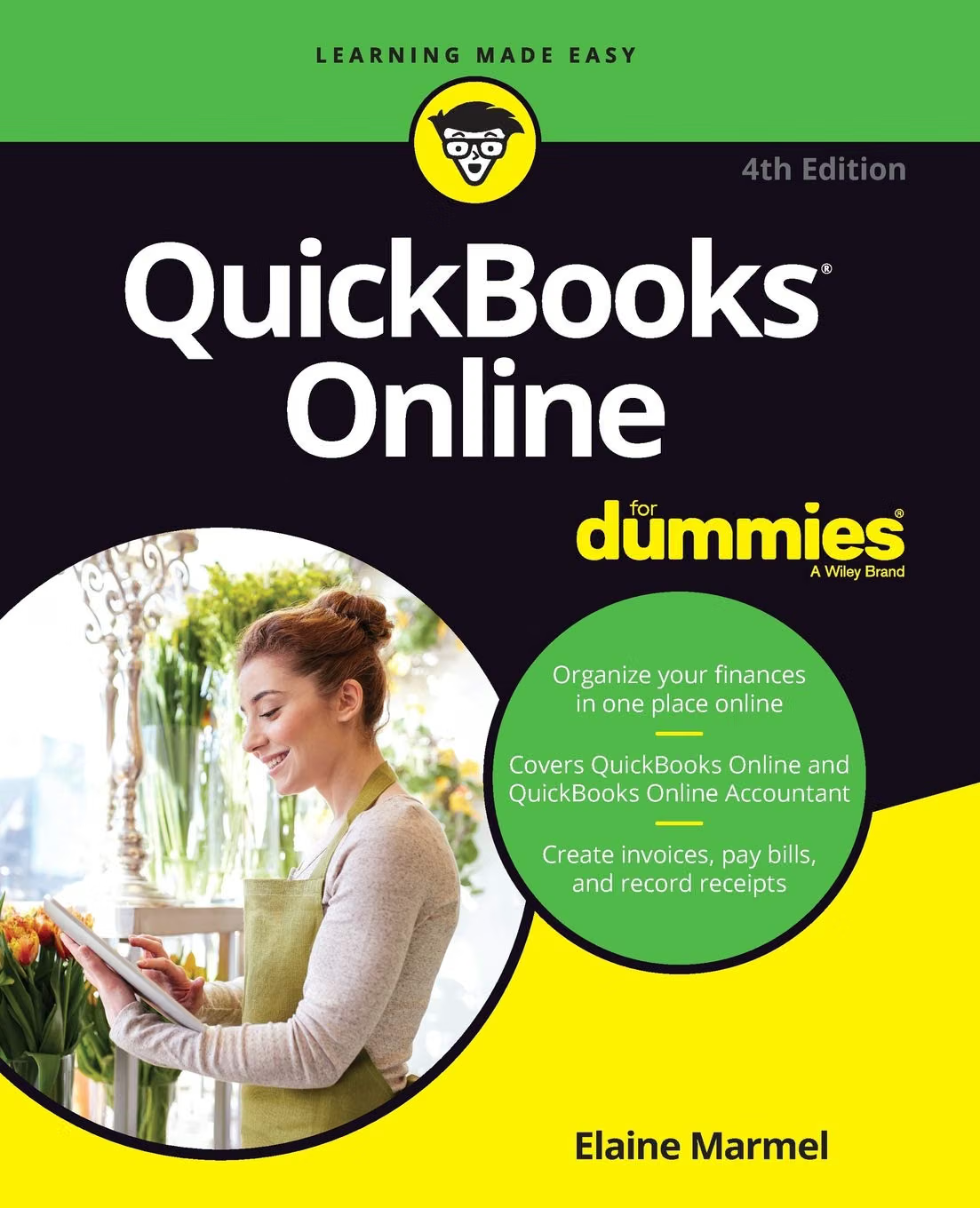
    QuickBooks Online For Dummies (For Dummies (Computer/Tech)) is designed to provide a structured introduction to QuickBooks Online and its accounting workflows. The specific Amazon-linked edition is the fourth edition by Elaine Marmel, published in 2018. It is a 416-page English-language paperback with ISBN-10 1119473934 and ISBN-13 9781119473930.

    The book covers a broad range of accounting activities. Its contents include creating a QuickBooks Online company, managing lists and accounts, handling money flowing into and out of a business, payroll, banking, reconciliations, reports, and working with accountants. It also addresses QuickBooks Online Accountant and data conversion from QuickBooks Desktop.

    That breadth makes the book potentially useful as a learning reference, particularly for people who are new to QuickBooks Online or who want to understand the basic structure of cloud-based bookkeeping.

    There is an important consideration, however: this particular edition is from 2018. QuickBooks Online has changed considerably over the years, and newer editions of QuickBooks Online For Dummies have been published since then. The 2026 edition, for example, covers newer areas such as Project Center and AI integration and was published in November 2025.

    Consequently, the 2018 edition should be viewed primarily as a foundational learning resource rather than a current manual for every feature available in QuickBooks Online today. Readers working with the current version of the software should verify current menus, workflows, subscription features, tax functionality, and integrations using up-to-date QuickBooks resources.

    What Is QuickBooks Online For Dummies?

    QuickBooks Online For Dummies is a technology and accounting guide written by Elaine Marmel. The edition associated with ISBN-10 1119473934 is the fourth edition, published in March 2018. It contains 416 pages and was published under the For Dummies brand.

    The book is intended to make QuickBooks Online easier to understand by organizing its major functions into practical sections.

    The contents are divided into several broad areas:

    • Getting started with QuickBooks Online and QuickBooks Online Accountant
    • Managing books for the end user
    • Creating and configuring a company
    • Managing list information
    • Handling money going out of the business
    • Managing money coming into the business
    • Banking and credit-card transactions
    • Payroll
    • Financial reporting
    • Accountant workflows
    • Client management
    • Data conversion
    • Productivity tips and shortcuts

    The original edition also explains concepts such as cloud computing, subscriptions, payroll requirements, switching from QuickBooks Desktop, third-party applications, multiple currencies, chart of accounts management, invoices, expenses, bank transactions, and reconciliation.

    This makes it more than a simple introduction to clicking around the QuickBooks interface. It provides a framework for understanding how the different parts of an accounting system fit together.

    Key Features and Learning Areas

    Getting Started With QuickBooks Online

    Beginning with accounting software can feel complicated because the software needs information about the business before transactions can be recorded correctly.

    The book introduces the process of creating a QuickBooks Online company and establishing company settings. It also discusses signing up, understanding the dashboard, configuring accounts, and working with the chart of accounts.

    These early steps matter because accounting records depend on consistent setup.

    For example, if income and expenses are assigned to inappropriate accounts, reports may become difficult to interpret later. Learning the purpose of the chart of accounts and other basic settings can therefore help users establish better bookkeeping habits from the beginning.

    Understanding Cloud Accounting

    One of the defining characteristics of QuickBooks Online is that it is cloud-based.

    Instead of installing a traditional desktop accounting application and keeping the primary working environment on one computer, users access the online service through an internet connection.

    The book introduces the concept of cloud accounting and discusses considerations surrounding the move to a cloud-based system.

    For business owners, this can change how financial information is accessed and shared. A business owner may work with an accountant remotely, while employees can potentially access relevant records according to the permissions assigned to them.

    However, cloud accounting also makes account security, user permissions, authentication, and data-management practices important considerations.

    Managing the Chart of Accounts

    The chart of accounts provides the structure used to classify financial transactions.

    A business may have accounts for income, operating expenses, assets, liabilities, equity, and other categories.

    Understanding this structure is fundamental to producing meaningful financial reports.

    The book’s introductory material includes updating and working with the chart of accounts, making this an important part of the learning process.

    For someone new to bookkeeping, the chart of accounts can initially appear abstract. Once the relationship between transactions and financial reports becomes clearer, however, it becomes easier to understand why accurate categorization matters.

    Recording Sales and Customer Transactions

    Businesses need a consistent way to record money received from customers.

    The book covers the inflow of money and includes subjects related to invoices, credit memos, customer transactions, and accounts receivable.

    A typical workflow might involve creating an invoice, recording the customer’s payment, and ensuring that the payment is associated with the correct account.

    For a service business, this could involve invoicing a client after completing a project. For a retail business, sales may be recorded through a different workflow.

    The exact process depends on how the business operates and how its QuickBooks account is configured.

    Tracking Expenses and Money Going Out

    Recording expenses is another core accounting activity.

    A business may have expenses involving rent, utilities, software subscriptions, advertising, equipment, transportation, supplies, professional services, and other operational costs.

    The book covers the handling of money flowing out of the business, including expenses, checks, bills, and credit-card charges.

    Understanding the distinction between different types of transactions is useful because recording an expense is not always the same as recording a bill that will be paid later.

    The timing of a transaction can affect how it appears in the accounting records, which is one reason bookkeeping workflows require consistency.

    Banking and Reconciliation

    Banking is one of the most important areas of practical bookkeeping.

    QuickBooks Online can work with bank and credit-card information, allowing users to review transactions and reconcile records.

    The book includes material covering bank and credit-card transactions and account reconciliation.

    Reconciliation involves comparing accounting records with information from financial institutions and investigating differences.

    This can help identify issues such as:

    • Missing transactions
    • Duplicate entries
    • Incorrect amounts
    • Transactions assigned to the wrong account
    • Timing differences
    • Unrecorded fees
    • Other discrepancies

    The purpose is not simply to make two numbers match. Reconciliation can help establish greater confidence that the accounting records reflect the underlying financial activity.

    Payroll

    Payroll introduces additional complexity because employee compensation can involve wages, deductions, taxes, reporting requirements, and payment schedules.

    The book includes coverage of payroll and paying employees.

    For a small business owner, understanding the accounting side of payroll can be useful even when payroll processing is handled by a dedicated service or accountant.

    At the same time, payroll and tax rules vary by jurisdiction and can change over time. A book published in 2018 should not be treated as a current source for payroll regulations.

    Inventory Management

    Inventory is another area covered by QuickBooks Online resources and the broader book ecosystem.

    Businesses that sell physical products may need to track quantities, purchasing, sales, and inventory-related accounting.

    Inventory management becomes more complicated as product catalogs grow. Businesses may also use specialized inventory systems or integrations.

    The 2018 edition introduces inventory-related functionality, while newer editions continue to address inventory and purchase orders.

    Financial Reports

    Financial reports transform individual transactions into information that can be used for decision-making.

    The book discusses generating income statements and financial reports.

    Reports can help business owners examine areas such as revenue, expenses, profitability, balances, and other financial information.

    However, a report is only as useful as the underlying data. Incorrect account classifications, missing transactions, or unreconciled accounts can reduce the usefulness of financial analysis.

    This is why bookkeeping fundamentals and reporting are closely connected.

    Working With Accountants

    One of the practical advantages of online accounting systems is that financial information can be shared with accounting professionals.

    The book includes dedicated material for accountants and QuickBooks Online Accountant workflows. Its contents cover adding companies to an accountant client list, exploring client companies, working inside client companies, and using accountant tools.

    This can be particularly relevant for small businesses that manage day-to-day transactions themselves but work with an accountant for financial review, tax preparation, or other professional services.

    QuickBooks Desktop Conversion

    Businesses moving from desktop accounting software may need to consider how existing data will be transferred.

    The book includes an appendix addressing QuickBooks Online, QuickBooks Desktop, and data conversion.

    Migration is an area where planning is important. Historical records, account mappings, customers, vendors, transactions, and other information may need to be reviewed.

    The exact migration process can change as software versions evolve, so current conversion documentation should be consulted before undertaking a real migration.

    How It Can Be Used

    Learning the Basics of Bookkeeping Software

    One of the most straightforward uses for the book is learning how an online accounting platform is organized.

    Someone new to QuickBooks Online can use the chapters to become familiar with company setup, accounts, customers, vendors, transactions, banking, and reports.

    Rather than attempting to understand every feature simultaneously, a reader can approach the material according to the needs of the business.

    Setting Up a Small Business Accounting Workflow

    A small business owner may use the book to understand the sequence involved in establishing accounting records.

    That can include:

    1. Creating the company profile
    2. Reviewing account settings
    3. Establishing the chart of accounts
    4. Adding customers and vendors
    5. Connecting or managing financial accounts
    6. Recording income and expenses
    7. Reconciling transactions
    8. Reviewing reports

    The exact setup depends on the business structure and accounting requirements.

    Learning How Transactions Flow Through the System

    Accounting software can seem easier to understand when users recognize that individual actions contribute to larger financial records.

    For example, an invoice is not merely a document sent to a customer. It can also create an accounts-receivable balance and later be affected when payment is received.

    Similarly, a bank transaction is not simply an entry in a bank feed. It needs to be categorized and reconciled appropriately.

    Thinking in terms of transaction flow can help users understand why accounting software has multiple connected screens and workflows.

    Preparing for Conversations With an Accountant

    A business owner does not need to perform every accounting task personally.

    However, understanding the basic vocabulary can make conversations with an accountant more productive.

    A business owner who understands terms such as reconciliation, accounts receivable, chart of accounts, expenses, payroll, and financial statements can better explain questions and understand professional recommendations.

    Supporting Remote Bookkeeping

    Because QuickBooks Online is cloud-based, bookkeeping can be performed in an environment designed for online access.

    This can be relevant to businesses where the owner, bookkeeper, and accountant are located in different places.

    The book’s discussion of QuickBooks Online and QuickBooks Online Accountant provides context for this collaborative approach.

    Who It May Be Suitable For

    Small Business Owners

    Small business owners often have to understand financial records even when accounting is not their primary profession.

    A structured guide can help them become more familiar with the software used to organize those records.

    Freelancers and Independent Professionals

    Freelancers may need to track client invoices, business expenses, payments, and financial reports.

    A basic understanding of accounting software can help create a more consistent bookkeeping routine.

    Bookkeeping Beginners

    Someone starting a bookkeeping role may find the book useful as an introductory reference.

    It explains many of the core workflows that appear in day-to-day accounting software use.

    Administrative Employees

    Employees who handle invoices, expenses, payments, or other financial administration may need to understand how their work affects the accounting system.

    Aspiring Accountants and Bookkeepers

    The book can provide an introduction to QuickBooks Online terminology and workflows before deeper accounting or software-specific training.

    Business Owners Working With Accountants

    Even when an accountant handles complex accounting and tax matters, a business owner may benefit from understanding how the underlying records are organized.

    Important Things to Consider

    The Amazon-Linked Edition Is From 2018

    This is the most important point when considering this particular edition.

    The ISBN 1119473934 identifies the fourth edition published in 2018.

    QuickBooks Online has changed significantly since then. Interface elements, subscription tiers, integrations, automation, reports, payroll functions, and other features may differ.

    For someone learning the current version of QuickBooks Online in 2026, a newer edition may contain more current instructions.

    Newer Editions Exist

    The publisher has released newer editions of QuickBooks Online For Dummies. The 2026 edition, written by David H. Ringstrom, was published in November 2025. It includes newer subjects such as Project Center and AI integration, along with updated interface and feature information.

    This does not make the older edition irrelevant. Foundational accounting concepts remain useful, but readers should distinguish between enduring accounting principles and instructions tied to an older version of the software.

    Accounting Rules Change

    Tax requirements, payroll rules, reporting standards, and government regulations can change.

    A general software guide should not be treated as a substitute for current tax guidance or professional accounting advice.

    This is particularly important when dealing with tax returns, payroll, sales tax, or other regulated financial activities.

    Software Interfaces Change

    Screenshots and step-by-step instructions can become outdated when software interfaces are redesigned.

    A reader may understand what a feature is supposed to accomplish but find that the relevant button or menu is located somewhere else in the current interface.

    This is a normal limitation of printed software manuals.

    Subscription Features Can Differ

    QuickBooks Online has different product configurations and subscription levels, and features can vary.

    The book discusses subscriptions and related functionality, but readers should verify current availability through Intuit’s current product information before assuming that a particular feature is included in their account.

    Data Accuracy Matters

    Accounting software can organize financial information, but it cannot automatically guarantee that every transaction is recorded correctly.

    Users still need appropriate bookkeeping procedures.

    A business should establish consistent rules for categorization, reconciliation, documentation, and review.

    Comparing General Categories of Accounting Learning Resources

    Printed QuickBooks Guide vs. Online Help

    A printed guide provides a structured learning sequence and can be convenient for studying away from the software.

    Online help has the advantage of being easier to update as software changes.

    For a current interface question, online documentation is generally more appropriate. For learning the broader workflow, a structured book can provide useful context.

    Beginner Guide vs. Accounting Textbook

    A QuickBooks guide focuses on using software to perform accounting-related tasks.

    An accounting textbook generally spends more time explaining accounting principles, financial statements, double-entry bookkeeping, and conceptual foundations.

    Someone learning accounting from the beginning may need both types of resources.

    Software Guide vs. Professional Accounting Advice

    A software guide can explain how a feature works.

    It cannot determine the correct tax treatment of a complex transaction for a particular business or jurisdiction.

    When financial or tax consequences are significant, professional advice and current official guidance may be appropriate.

    Older Edition vs. Current Edition

    Older editions can still provide useful explanations of fundamental workflows.

    Current editions are generally more relevant when the goal is to follow the latest interface and features.

    For the specific Amazon-linked 2018 edition, readers should be particularly aware of this distinction because QuickBooks Online has continued to evolve.

    Practical Learning Approach

    A useful way to study accounting software is to practice with a controlled example rather than immediately changing important business records.

    For example, a learner could create a conceptual sample business and think through a simple cycle:

    A customer receives an invoice. The invoice creates an amount due. The customer later pays. The payment is recorded. The bank transaction appears in the financial records. The account is reconciled. Finally, the resulting information appears in a financial report.

    This simple scenario connects several different parts of an accounting system.

    The same approach can be used for expenses. Consider a business that receives a bill from a supplier, records the obligation, pays it later, and then reconciles the bank transaction.

    Once the relationship between these stages becomes clear, the software’s menus and forms are easier to understand.

    Another useful habit is to distinguish between learning the software and learning accounting itself. The first question is “How do I enter this transaction?” The second is “What kind of transaction is this, and how should it affect the financial records?”

    Both questions matter.

    Frequently Asked Questions

    What is QuickBooks Online For Dummies?

    It is a guide to using QuickBooks Online for business accounting and bookkeeping tasks. The Amazon-linked edition is the fourth edition written by Elaine Marmel and published in 2018.

    Who wrote the Amazon-linked edition?

    The edition associated with ISBN-10 1119473934 was written by Elaine Marmel.

    How many pages does this edition have?

    The fourth edition contains 416 pages.

    What is the ISBN?

    The ISBN-10 is 1119473934, and the ISBN-13 is 9781119473930.

    When was this edition published?

    The fourth edition was published in March 2018.

    Does the book explain how to create a QuickBooks Online company?

    Yes. Company creation and setup are included in the book’s contents, including company settings and initial configuration.

    Does it cover invoices?

    Yes. The book covers invoicing and customer-related transactions as part of its discussion of money coming into the business.

    Does it explain expenses?

    Yes. The book includes workflows involving expenses, checks, bills, and credit-card charges.

    Does it cover payroll?

    Yes. Payroll and paying employees are among the accounting functions addressed by the book.

    Does the book discuss bank reconciliation?

    Yes. Banking, credit-card transactions, and account reconciliation are included in the book’s coverage.

    Can it help with financial reports?

    Yes. The book includes material on generating financial reports and understanding business financial information.

    Does it cover QuickBooks Online Accountant?

    Yes. The book contains dedicated sections dealing with QuickBooks Online Accountant and accountant workflows, including client companies and accountant tools.

    Does it explain moving from QuickBooks Desktop?

    Yes. The edition includes an appendix addressing QuickBooks Online, QuickBooks Desktop, and data conversion.

    Is this edition current for 2026?

    No. The Amazon-linked edition is from 2018. QuickBooks Online has changed since then, and newer editions have been released. The 2026 edition was published in November 2025 and covers newer functionality.

    Can an older QuickBooks guide still be useful?

    Yes, particularly for learning fundamental accounting workflows and terminology. However, current interface instructions and feature availability should be verified against current QuickBooks resources.

    Is the book a replacement for an accountant?

    No. A software guide explains how accounting software can be used, but it does not replace professional accounting or tax advice.

    Can beginners use the book?

    The book is structured as a For Dummies technology guide and covers fundamental setup and bookkeeping workflows, making it relevant to people learning QuickBooks Online.

    Does QuickBooks Online work entirely offline?

    QuickBooks Online is a cloud-based service, so access depends on the online service and an internet connection. The book specifically introduces the cloud-based nature of the platform.

    Does the book cover multiple currencies?

    Yes. Multiple-currency functionality is included among the subjects discussed in the book’s setup material.

    Does it cover third-party applications?

    Yes. The book discusses where add-on applications fit into QuickBooks Online.

    Conclusion

    QuickBooks Online For Dummies (For Dummies (Computer/Tech)) provides a structured introduction to QuickBooks Online and the bookkeeping workflows surrounding it. The specific edition associated with the Amazon product link is Elaine Marmel’s fourth edition, published in 2018, with 416 pages and ISBN-10 1119473934.

    Its coverage extends across many of the activities that small businesses encounter in everyday financial administration: company setup, chart of accounts, customers, invoices, expenses, banking, reconciliation, payroll, inventory, reports, and accountant collaboration.

    The book can be useful for someone who wants to understand how the pieces of an online accounting system fit together. It can also provide a vocabulary for communicating with bookkeepers and accountants and a framework for learning basic QuickBooks workflows.

    The publication date is an important consideration. QuickBooks Online is continually updated, and newer editions of the For Dummies series now cover functionality that did not exist in the 2018 edition. The current 2026 edition, for example, addresses newer areas such as Project Center, AI integration, updated workflows, spreadsheet tools, and other features.

    For that reason, the 2018 edition is most appropriately viewed as a foundational reference rather than a definitive guide to the current QuickBooks Online interface. Readers dealing with current tax requirements, payroll regulations, subscription features, or important financial records should verify information using current official resources and, when appropriate, qualified accounting professionals.

    For readers who want to explore the edition associated with the Amazon listing and learn more about its approach to QuickBooks Online,

    you can check more details on Amazon here.

  • Tech for Product Managers: Tech Case Studies & Concepts Explained

    Tech for Product Managers: Tech Case Studies & Concepts Explained

    Introduction

    Product management sits at the intersection of business goals, customer needs, design, data, and technology. A product manager does not necessarily need to write production code or design complex infrastructure, but understanding how technology works can make it considerably easier to communicate with engineers, evaluate technical tradeoffs, understand product limitations, and make informed decisions.

    Tech for Product Managers: Tech Case Studies & Concepts Explained by Shailesh Sharma is a technology-focused guide intended to help product managers develop that technical foundation. The book was independently published in 2025 and is listed under ISBN-13 9798305851793. Available bibliographic information describes it as a 130-page English-language paperback.

    The central idea behind the book is straightforward: product managers benefit from understanding the technology behind the products they help define. Instead of treating engineering concepts as a separate discipline, the book connects technical subjects with product development and decision-making.

    Its scope is relatively broad. The listed subjects include software development life cycles, technology fundamentals, mobile and web applications, databases, application architecture, web technologies, APIs, system design, cloud computing, A/B testing, machine learning, artificial intelligence, augmented and virtual reality, big data, and the Internet of Things.

    That range makes the book potentially useful as a bridge between product strategy and technical implementation. A product manager can encounter all of these areas during a career, even when their role does not require them to become a specialist in every technology.

    The book is also built around case-study-oriented learning. Shailesh Sharma has published product-management material using practical scenarios, including case studies involving products and technology companies.

    For readers considering this book, however, it is helpful to set realistic expectations. A concise product-management technology guide is not a replacement for a computer science degree, engineering documentation, or specialized courses in areas such as distributed systems or machine learning. Its role is better understood as an accessible foundation that helps product professionals develop technical vocabulary and reasoning skills.

    What Is Tech for Product Managers?

    Tech for Product Managers: Tech Case Studies & Concepts Explained is a technology and product-management book written by Shailesh Sharma. It was published independently in 2025. The available edition information identifies the book as a paperback with ISBN-13 9798305851793.

    The book focuses on explaining technical concepts from the perspective of product management. Its stated subjects cover both foundational technology and more advanced areas.

    Among the topics identified in published descriptions are:

    • Software Development Lifecycle
    • Technology fundamentals
    • Mobile and web application basics
    • Databases
    • Application architecture
    • HTTP and REST APIs
    • Front-end development
    • System design
    • Consistent hashing
    • CAP theorem
    • Load balancing
    • Caching
    • SQL and NoSQL databases
    • Data partitioning
    • Cloud computing
    • A/B testing
    • Machine learning
    • Artificial intelligence
    • Machine-learning algorithms
    • Augmented reality
    • Virtual reality
    • Big data
    • Internet of Things

    The breadth of this list illustrates an important point about modern product management. Technical knowledge is not limited to understanding how software is coded. Product decisions can involve infrastructure, data storage, experimentation, scalability, cloud services, artificial intelligence, and connected devices.

    A product manager who understands the basic principles behind these technologies can ask more informed questions and participate more effectively in technical discussions.

    Key Features and Learning Areas

    Understanding Why Technology Matters to Product Management

    One of the book’s fundamental themes is the connection between technology and product decisions.

    Product managers frequently need to balance competing requirements. A feature might be valuable to customers but technically expensive. Another feature might be simple to implement but have limited impact. A third option could provide significant long-term value while requiring architectural changes.

    Without some technical understanding, it can be difficult to understand why engineering teams recommend one approach over another.

    Technical knowledge does not mean that a product manager needs to dictate implementation details. Instead, it can help the product manager understand constraints, identify tradeoffs, and ask useful questions.

    For example, knowing the difference between a database query and an API request can make a technical conversation much easier to follow. Understanding caching can help explain why users may sometimes see older information. Understanding scalability can clarify why a solution that works for 10,000 users may require a different architecture at 10 million users.

    These concepts become part of the product manager’s decision-making vocabulary.

    Software Development Lifecycle

    The Software Development Lifecycle, or SDLC, provides a framework for understanding how software moves from an idea toward a working product and ongoing maintenance.

    For a product manager, the SDLC can provide useful context around requirements, design, development, testing, deployment, monitoring, and iteration.

    Understanding these stages can improve planning. A feature that looks simple from a customer perspective may involve multiple engineering tasks, testing requirements, database changes, security considerations, or deployment dependencies.

    The product manager does not necessarily perform these technical tasks, but understanding where they fit can make project planning more realistic.

    Technology Fundamentals

    Technology terminology can sometimes become a barrier between product and engineering teams.

    Terms such as server, client, database, API, framework, cloud, backend, frontend, and infrastructure appear regularly in technology organizations.

    A product manager who understands the basic meaning of these terms can participate in technical conversations without needing to become a software engineer.

    This is particularly relevant for aspiring product managers who come from business, marketing, finance, design, or other non-engineering backgrounds.

    Mobile and Web Applications

    Modern products often operate across multiple environments.

    A website might have a frontend that runs in a browser and a backend that processes requests. A mobile application may communicate with remote services through APIs while storing some information locally on a phone.

    Understanding these components can help a product manager think more clearly about product requirements.

    For example, a request such as “users should be able to continue using the app when they temporarily lose internet access” is not simply a user-interface requirement. It can involve local data storage, synchronization, conflict resolution, and backend behavior.

    A technical foundation helps the product manager recognize these implications earlier.

    Databases

    Databases are fundamental to many digital products.

    The book introduces database concepts and discusses different approaches to storing and managing information. Its listed topics include SQL and NoSQL databases.

    For product managers, database knowledge can be useful when thinking about:

    • Customer profiles
    • Orders
    • Transactions
    • Search
    • Product catalogs
    • Analytics
    • Content
    • Relationships between records
    • Data consistency
    • Performance

    A product manager does not need to design database schemas personally in every situation, but understanding why different database technologies exist can help when discussing product requirements.

    Application Architecture

    Application architecture describes how the major components of a software system are organized and communicate.

    Architecture decisions can affect performance, scalability, reliability, development speed, and operational complexity.

    For product managers, the key lesson is not memorizing every architectural pattern. It is understanding that technical architecture creates product-level consequences.

    A product requirement may influence architecture, while architectural limitations may influence which product requirements are practical.

    This creates a two-way relationship between product strategy and engineering.

    Web Technologies and APIs

    HTTP and REST APIs are specifically identified among the subjects covered by the book.

    An API can be thought of as a structured way for software components to communicate.

    For example, a mobile application might request account information from a backend service through an API. The backend processes the request and returns information that the application can display.

    Understanding this basic flow can help product managers reason about integrations and dependencies.

    If a product needs to connect with a payment provider, mapping service, authentication system, analytics platform, or another external service, APIs may become part of the implementation.

    System Design

    System design is one of the more technical subjects listed in the book.

    The described topics include consistent hashing, the CAP theorem, load balancing, caching, SQL versus NoSQL, and data partitioning.

    These concepts are particularly relevant when products grow.

    A small application may work adequately with a simple architecture. As traffic, users, data volume, and geographic distribution increase, engineering teams may need more sophisticated approaches.

    A product manager does not need to implement consistent hashing or configure load balancers, but understanding why such technologies exist can provide valuable context when discussing scalability.

    Cloud Computing

    Cloud computing has become an important part of modern software development.

    Cloud platforms can provide computing resources, storage, databases, networking, monitoring, and other services without requiring an organization to operate every physical component itself.

    For product managers, cloud concepts can help explain questions surrounding scalability, deployment, infrastructure costs, reliability, and geographic availability.

    Cloud architecture can also affect product strategy. For example, supporting users in multiple regions may introduce requirements involving latency, data residency, redundancy, and regional infrastructure.

    A/B Testing

    Product decisions often involve uncertainty.

    An A/B test provides one way to compare different versions of a product experience using measured outcomes.

    The book includes A/B testing among its technology and product-development topics.

    For product managers, understanding experimentation means more than knowing how to create two versions of a button.

    A useful experiment requires a clear hypothesis, an appropriate metric, a defined population, and a reasonable interpretation of the results.

    Poorly designed experiments can produce misleading conclusions. Factors such as sample size, selection bias, experiment duration, seasonality, and statistical uncertainty can affect interpretation.

    A technical foundation therefore supports better product experimentation.

    Machine Learning and Artificial Intelligence

    Machine learning and artificial intelligence are among the more contemporary topics covered by the book.

    The published description indicates that the book introduces machine-learning concepts, popular algorithms, and case studies involving machine learning.

    For product managers, AI knowledge can be useful because machine-learning systems differ from traditional software in important ways.

    A traditional feature might produce predictable output from explicitly programmed rules. A machine-learning system may generate predictions based on patterns learned from data.

    That introduces additional product questions:

    • What data is available?
    • How reliable is the data?
    • What does the model predict?
    • How will accuracy be measured?
    • What happens when the model is wrong?
    • How frequently should it be updated?
    • What risks arise from biased or incomplete data?
    • How should users understand automated decisions?

    These questions connect technology directly to product design.

    Augmented and Virtual Reality

    AR and VR are also included among the book’s listed topics.

    These technologies introduce different interaction models from traditional websites and mobile applications.

    Augmented reality can place digital information within a user’s physical environment, while virtual reality can create an immersive digital environment.

    From a product-management perspective, the technology should not be viewed independently from the user problem. The important question is not simply whether AR or VR can be implemented, but whether the technology creates a meaningful experience for the intended audience.

    Big Data

    As products generate larger quantities of information, data infrastructure becomes increasingly important.

    Big-data concepts can involve storage, processing, analytics, distributed systems, and the ability to extract useful information from large datasets.

    For product managers, this can affect analytics strategy, personalization, recommendation systems, reporting, and operational decision-making.

    The book’s inclusion of big data alongside machine learning and system design reflects how closely these areas can intersect in modern products.

    Internet of Things

    The Internet of Things connects physical devices to digital systems.

    Examples include connected appliances, sensors, wearable devices, industrial equipment, and smart-home products.

    IoT products can create additional product-management challenges because they combine hardware, software, connectivity, data, and sometimes cloud infrastructure.

    A product manager working on an IoT product may need to consider device reliability, connectivity interruptions, firmware updates, data security, physical environments, and user installation.

    Understanding these concepts can help bridge the gap between a physical product and its associated digital services.

    How the Book Can Be Used

    As a Technical Foundation for Aspiring Product Managers

    Someone preparing for a product-management career may encounter technical vocabulary during interviews, case studies, or conversations with engineering teams.

    A structured introduction can help reduce that learning gap.

    Instead of studying isolated definitions, readers can use the book’s range of topics to build a broad map of the technology landscape.

    As a Reference During Product Work

    Product managers frequently encounter unfamiliar technical concepts.

    A project might involve an API one month, database architecture the next, and machine-learning experimentation later.

    A broad reference can help a product manager understand the terminology before having a deeper conversation with technical specialists.

    As Interview Preparation

    Technical product-management interviews can involve questions about system design, architecture, experimentation, data, and technology tradeoffs.

    The book’s combination of concepts and case-study-oriented material can be relevant to this preparation.

    Shailesh Sharma has also published product-management interview material and case-study discussions, including examples involving product design scenarios.

    A reader should still supplement any book with current interview expectations and hands-on practice.

    As a Bridge Between Business and Engineering

    One of the most useful applications of technical knowledge is communication.

    A product manager often has to translate customer and business requirements into language that engineering teams can act upon, while also explaining technical constraints to nontechnical stakeholders.

    Knowing the underlying concepts can make that translation more precise.

    As a Starting Point for Deeper Study

    A broad introductory book can also help identify areas worth studying in greater depth.

    A reader might discover an interest in:

    • Distributed systems
    • Cloud architecture
    • Machine learning
    • Data engineering
    • APIs
    • Databases
    • Mobile development
    • Artificial intelligence
    • IoT

    The book can therefore serve as a map of the technical landscape rather than an exhaustive course in every topic.

    Who It May Be Suitable For

    Aspiring Product Managers

    People preparing for their first product-management role may find the technical vocabulary useful, particularly if they do not have a computer science background.

    Current Product Managers

    Experienced product managers can also encounter technical areas outside their previous experience. A broad reference can help fill knowledge gaps.

    Associate Product Managers

    APMs often work closely with engineers and designers while learning product-development processes. Technical fundamentals can help them participate more confidently in those conversations.

    Business and Strategy Professionals

    People transitioning from business strategy, consulting, operations, marketing, or finance into technology product management may benefit from a technology primer.

    Founders and Entrepreneurs

    Startup founders frequently make product decisions without having large specialized teams. Understanding the basics of APIs, architecture, databases, cloud infrastructure, and experimentation can help founders communicate with developers and evaluate technical proposals.

    Designers Interested in Product Development

    Product designers increasingly work in cross-functional teams. Understanding technical constraints can help designers anticipate implementation considerations and communicate more effectively with engineering.

    Important Things to Consider

    It Is a Broad Introduction, Not a Complete Computer Science Course

    The book covers many subjects, but breadth and depth are different things.

    A short book covering databases, system design, cloud computing, machine learning, AI, AR/VR, big data, and IoT cannot provide the same depth as specialized technical textbooks or university courses in each discipline.

    Readers should approach it as a foundation.

    Technical Knowledge Does Not Replace Engineering Expertise

    A product manager’s technical literacy should support collaboration rather than replace specialized engineering judgment.

    Understanding what a load balancer does is different from being able to design and operate a production-scale distributed system.

    The distinction is important when translating technical knowledge into professional responsibilities.

    Technology Changes Quickly

    Technology evolves rapidly, particularly in areas such as artificial intelligence, cloud platforms, developer tools, and application architecture.

    A book published in 2025 provides a snapshot of its publication period. Current technologies, terminology, and practices may continue to change.

    Readers working on active products should verify implementation details using current technical documentation.

    Case Studies Need Context

    Case studies can be valuable because they show how abstract concepts relate to real products.

    However, a case study necessarily simplifies reality.

    Real product decisions may involve legal requirements, organizational politics, existing infrastructure, budgets, security constraints, customer contracts, and technical debt that are not fully represented in a simplified example.

    Case studies should therefore be used to practice reasoning rather than copied as universal formulas.

    Technical Decisions Have Product Consequences

    A technical decision should not be evaluated solely from an engineering perspective.

    For example, an architecture that increases reliability might also increase development or infrastructure complexity. A sophisticated machine-learning model might improve prediction quality but introduce operational and monitoring requirements.

    Product managers need to understand these tradeoffs in the context of customer and business goals.

    Comparing General Categories of Product-Management Learning Resources

    Technology Primer vs. Computer Science Textbook

    A technology primer is designed to provide breadth and practical context.

    A computer science textbook generally explores concepts more deeply and systematically.

    For a product manager who needs working knowledge across many technology areas, breadth may be useful. Someone preparing for an engineering career would typically need considerably deeper technical study.

    Case-Study Book vs. Theory-Focused Resource

    Case studies can make abstract concepts easier to connect to practical product decisions.

    Theory-focused resources may provide more detailed explanations of the underlying mathematics, algorithms, or engineering principles.

    The two approaches can complement one another.

    Product Management Book vs. Engineering Book

    A conventional product-management book may focus heavily on discovery, prioritization, roadmaps, metrics, customer research, and stakeholder management.

    An engineering book may focus on implementation, architecture, algorithms, or infrastructure.

    A technology guide for product managers sits between these categories. Its purpose is to help product professionals understand the technical environment in which their decisions are implemented.

    Broad Guide vs. Specialized Course

    A broad book can introduce many areas quickly.

    A specialized course can spend substantially more time on a particular subject, often including exercises and projects.

    Someone who discovers a strong interest in system design or machine learning may therefore use an introductory guide as the starting point before moving to more specialized material.

    Practical Ways to Apply the Concepts

    Reading technical material becomes more useful when connected to actual product scenarios.

    Consider an imaginary shopping application. A product manager could use the book’s concepts to ask how product searches are processed, where customer information is stored, how APIs connect the mobile application to backend services, and what happens when traffic increases.

    Consider an online learning platform. The product manager might need to think about video delivery, user accounts, analytics, experimentation, and cloud infrastructure.

    Consider a smart-home product. IoT concepts become relevant because the physical device must communicate with software services while dealing with connectivity, updates, data, and security.

    Consider an AI-powered recommendation feature. Machine learning, data quality, experimentation, model performance, and user experience all become connected product considerations.

    These scenarios demonstrate why technical knowledge can be valuable even when a product manager is not responsible for writing the underlying code.

    Frequently Asked Questions

    Who wrote Tech for Product Managers: Tech Case Studies & Concepts Explained?

    The book was written by Shailesh Sharma. Bibliographic listings identify the author as Shailesh Sharma and the publisher as Independently published.

    When was the book published?

    Available bibliographic information identifies 2025 as the publication year.

    What is the ISBN?

    The paperback edition is listed with ISBN-13 9798305851793.

    How long is the book?

    The available book listing describes a 130-page edition.

    Is this book only for experienced product managers?

    No. The described audience includes aspiring and current product managers, as well as people interested in understanding the technology landscape behind modern products.

    Does the book explain databases?

    Yes. Database concepts are among the listed subjects, including different database approaches and SQL versus NoSQL.

    Does it cover APIs?

    Yes. The book includes web-technology concepts such as HTTP and REST APIs.

    Does it discuss system design?

    Yes. The listed system-design topics include consistent hashing, the CAP theorem, load balancing, caching, SQL versus NoSQL, and data partitioning.

    Does the book cover artificial intelligence?

    Yes. Artificial intelligence and machine learning are among the technology areas included in the book.

    Does it include machine-learning case studies?

    The published description states that the book covers popular machine-learning algorithms and includes machine-learning case studies.

    Does it cover cloud computing?

    Yes. Cloud computing is specifically included among the book’s technology topics.

    Does it discuss A/B testing?

    Yes. A/B testing is listed as one of the subjects covered.

    Does the book cover AR and VR?

    Yes. Augmented reality and virtual reality are included in the published description of the book’s topics.

    Does it discuss Internet of Things technology?

    Yes. IoT is included among the technologies discussed.

    Is this book useful for someone without a computer science degree?

    The book is specifically positioned toward product managers and aspiring product managers who want to strengthen their technical understanding. That makes it relevant to readers whose primary background is not computer science.

    However, readers should distinguish between learning technical concepts and acquiring professional engineering expertise.

    Can the book replace technical training?

    It is better viewed as a foundation or reference rather than a complete substitute for specialized technical education. Its broad scope covers many areas, while individual subjects such as distributed systems, databases, cloud architecture, or machine learning can require much deeper study.

    How can product managers benefit from technical knowledge?

    Technical knowledge can help product managers understand implementation constraints, communicate with engineers, evaluate tradeoffs, ask more precise questions, and connect technical decisions with customer and business requirements.

    Does technical knowledge mean a product manager needs to become a programmer?

    Not necessarily. Product management and software engineering are different disciplines. A product manager can benefit substantially from understanding technical concepts without becoming responsible for implementing every technical component.

    Conclusion

    Tech for Product Managers: Tech Case Studies & Concepts Explained approaches technology from a product-management perspective, with the goal of helping readers understand the technical systems behind modern digital products.

    Written by Shailesh Sharma and independently published in 2025, the book covers a wide range of subjects, including software development, applications, databases, architecture, APIs, system design, cloud computing, experimentation, machine learning, artificial intelligence, AR/VR, big data, and IoT.

    Its broad coverage makes the book particularly relevant to readers who need technical literacy rather than deep specialization in a single engineering discipline. For aspiring product managers, it can provide vocabulary and context. For current product managers, it can serve as a reference when unfamiliar technical subjects arise. For professionals moving from business-oriented roles into technology, it can help make engineering conversations easier to understand.

    The most useful way to approach technical knowledge in product management is not as an attempt to replace engineers. Instead, it is a way to improve collaboration and decision-making. A product manager who understands APIs, databases, architecture, experimentation, cloud infrastructure, and AI concepts can better recognize how technical choices affect customers and business objectives.

    At the same time, readers should keep the book’s scope in perspective. Its broad coverage means individual technical subjects cannot be explored with the same depth as dedicated engineering textbooks or specialized courses. Technology also changes quickly, so current documentation and contemporary technical resources remain important when making implementation decisions.

    For anyone looking to build a stronger bridge between product strategy and technology, the book provides a structured collection of concepts and case-study-oriented material to explore.

    You can check more details on Amazon here.

  • Zoom For Dummies: A Practical Guide to Learning Zoom for Work, School, and Everyday Communication

    Zoom For Dummies: A Practical Guide to Learning Zoom for Work, School, and Everyday Communication

    Introduction

    Video communication has become an important part of modern work, education, business, and personal communication. Instead of traveling to an office, classroom, conference center, or family gathering, people can connect through an internet-based meeting platform from a computer, tablet, or smartphone. Zoom became one of the most widely recognized platforms in this area, but its range of features can make it difficult for a new user to understand where to begin.

    That is the problem addressed by Zoom For Dummies, written by Phil Simon and published by the For Dummies imprint in 2020. The paperback edition associated with ISBN-10 1119742145 and ISBN-13 978-1119742142 is a 400-page introductory technology book designed to explain Zoom and its broader communication tools.

    Rather than treating Zoom as simply a way to make video calls, the book explores a wider collection of functions, including meetings, chat, webinars, screen sharing, security practices, third-party applications, Zoom Rooms, and Zoom Phone. Its table of contents moves from basic account and meeting setup toward more advanced organizational uses.

    This makes Zoom For Dummies relevant to more than someone who simply wants to join a meeting. A new Zoom user may want to understand how meetings are created and managed, while a small business owner may be interested in collaboration and webinars. A teacher or trainer may need to understand screen sharing and participant management. Someone responsible for technology at an organization may also find the sections about security, integrations, Zoom Rooms, and deployment useful as background information.

    One important consideration, however, is the book’s publication date. The print edition was published in 2020, and software platforms can change considerably over several years. Zoom has continued developing its services and interface since the book was released. Therefore, the book is best understood as a structured learning resource for Zoom concepts and workflows rather than a guarantee that every button, menu, subscription option, or feature described will look exactly the same today.

    For readers who want a foundation for understanding Zoom, this distinction is useful. The underlying ideas of online meetings, account management, collaboration, security, webinars, and communication remain valuable, while current software instructions should be checked against up-to-date Zoom documentation when necessary.

    What Is Zoom For Dummies?

    Zoom For Dummies is a technology guide written by Phil Simon and published by John Wiley & Sons under the For Dummies brand. The paperback edition contains 400 pages and was published in August 2020.

    The book is structured for beginners but goes beyond the most basic introduction to the platform. Its contents are divided into several broad areas. Early chapters introduce Zoom and its communication tools, followed by instructions and explanations concerning account setup, meetings, contacts, chat, and other functions. Later sections move toward third-party applications, webinars, security, Zoom Rooms, Zoom Phone, organizational adoption, and future developments.

    This structure is important because Zoom is not a single-purpose video calling application. Its ecosystem has included multiple communication and collaboration services, and users may interact with different parts of that ecosystem depending on their role.

    For someone who has only used Zoom occasionally, the book can provide context for understanding what the different tools are designed to accomplish. Instead of learning individual commands without understanding the larger picture, readers can see how meetings, messaging, webinars, applications, and organizational communication relate to one another.

    The book also contains a dedicated section covering common myths and practical tips, along with resources and ideas for using Zoom socially. This broadens the discussion beyond strictly technical instructions.

    Key Features and Areas Covered

    Meeting Setup and Account Basics

    One of the most important subjects for a new Zoom user is getting the initial setup right. Before hosting meetings, users need to understand accounts, roles, meeting options, and the difference between participating in a meeting and managing one.

    The book dedicates an entire chapter to setting up Zoom, including first steps, account management, and Zoom roles.

    These concepts become increasingly important when Zoom is used in professional environments. A person who only joins meetings may have limited responsibilities, while a meeting host or administrator can have considerably more control over the session.

    Understanding this distinction can help users avoid confusion when a feature is available to a host but not to an ordinary participant.

    Zoom Meetings

    Meetings form the foundation of the Zoom experience. Zoom For Dummies covers getting started with meetings, hosting them, and performing actions while a meeting is in progress.

    For beginners, learning the meeting workflow can involve several separate tasks:

    • Joining a meeting
    • Creating a meeting
    • Inviting participants
    • Managing audio and video
    • Understanding participant controls
    • Sharing content
    • Communicating through chat
    • Handling meeting settings
    • Ending a meeting properly

    Learning these elements systematically can make online meetings less intimidating, especially for users who are not comfortable with technology.

    Screen and Content Sharing

    Screen sharing is one of the features that makes video conferencing useful for work and education. Instead of only speaking to participants, a presenter can demonstrate a document, application, presentation, website, or other digital content.

    The official For Dummies material specifically highlights screen and file sharing as part of the book’s coverage.

    This can be useful for several situations. A teacher might demonstrate software to students. A manager could present information during a team meeting. A technical support employee could explain a process visually. A freelancer might walk a client through a project.

    Screen sharing also introduces practical considerations. Users should know exactly what is visible before sharing a desktop, particularly when confidential messages, notifications, personal documents, or other private information may appear on screen.

    Zoom Chat and Contacts

    Zoom’s communication environment extends beyond video meetings. The book includes material on managing contacts, user status, chatting, searching within Zoom, and working with messaging groups.

    This is useful because collaboration does not always require a video call. A short written message may be more appropriate than scheduling a meeting for every question.

    Understanding chat and contact management can therefore help users decide when a meeting is necessary and when a message is sufficient.

    Webinars

    Another major subject covered in the book is Zoom’s webinar functionality. The relevant chapter discusses starting, running, and concluding webinars.

    Webinars are different from ordinary meetings because they are generally structured around presentation and audience participation rather than an informal group conversation.

    This distinction can matter for organizations that host:

    • Online training sessions
    • Educational presentations
    • Product demonstrations
    • Public information sessions
    • Professional events
    • Large-scale presentations

    The book provides an introduction to the concept so readers can understand how webinars fit into Zoom’s broader communication ecosystem.

    Third-Party Applications

    Modern communication platforms often connect with other applications, and Zoom For Dummies includes a section on Zoom’s App Marketplace and third-party applications.

    The practical value of this topic is that users can begin thinking about Zoom as part of a larger technology environment rather than an isolated application.

    However, third-party integrations should be approached carefully. Adding an external application may involve permissions, account access, data handling, and administrative considerations. The book itself includes a section about approaching applications carefully, which is particularly relevant for business users.

    Security and Privacy

    Security is another significant subject. The book dedicates an entire chapter to protecting communications and discusses privacy and security configuration.

    This is an important part of learning any communication platform. Video meetings can contain private conversations, company information, educational material, client discussions, or personal information.

    Good security habits can include understanding meeting access controls, keeping software updated, using appropriate account settings, and considering who has permission to access recordings or shared information.

    Because security practices and platform capabilities can change over time, readers should also consult current Zoom documentation for the latest settings and recommendations rather than relying exclusively on a guide published in 2020.

    Zoom Rooms and Organizational Deployment

    The book goes beyond individual users by discussing Zoom Rooms and broader organizational adoption.

    Zoom Rooms are designed around dedicated meeting spaces rather than a single person using a laptop. This introduces additional considerations involving room equipment, displays, cameras, microphones, and organizational management.

    For small businesses, these concepts can help explain what changes when video conferencing becomes part of a company’s physical infrastructure.

    Zoom Phone

    Another section discusses Zoom Phone and basic calling functionality.

    This is relevant because communication platforms can extend beyond video meetings into business calling. A user interested only in video conferencing may not need this information immediately, but understanding the broader platform can help explain why organizations may use multiple Zoom services together.

    How Zoom For Dummies Can Be Used

    Learning Zoom From the Beginning

    The most straightforward use is as a beginner’s learning guide.

    Someone who has recently started using Zoom can work through the introductory concepts and gradually move toward more advanced features. This approach can be particularly helpful for people who prefer structured written instructions instead of learning entirely through trial and error.

    The book’s beginner classification and extensive table of contents make it possible to focus on particular topics without necessarily treating the book as something that must be read from beginning to end.

    Preparing to Host Meetings

    There is an important difference between joining a meeting and hosting one. Hosts have additional responsibilities, including managing participants and configuring meeting options.

    The book’s dedicated coverage of meeting setup and hosting can help readers understand these responsibilities before organizing their first important online session.

    For example, someone preparing for a remote team meeting could use the material to become familiar with meeting controls before the actual event.

    Supporting Remote Work

    Remote work often involves more than video conversations. Teams may need chat, file sharing, screen sharing, scheduling, and other collaborative tools.

    The book approaches Zoom from the broader perspective of communication and collaboration, making it potentially useful for people trying to understand how different features can fit into a remote-work routine.

    Supporting Online Education

    Teachers, instructors, tutors, and students can encounter many of the same challenges as business users. They need to understand meetings, audio and video controls, screen sharing, chat, and participant interaction.

    The book’s coverage of these areas can provide a foundation for learning how video conferencing works in an educational environment.

    However, educational institutions may also have specific privacy, accessibility, and administrative requirements. Those requirements should be addressed through the institution’s own policies and current Zoom documentation.

    Learning Through Reference Rather Than Linear Reading

    A technology book does not always need to be read like a novel.

    The chapter structure makes Zoom For Dummies suitable as a reference guide. A reader who already understands meetings could skip introductory material and focus on webinars, applications, security, organizational deployment, or other subjects.

    The published contents specifically include sections ranging from basic setup to advanced organizational topics.

    Who It May Be Suitable For

    Beginners

    People who have little experience with Zoom may benefit from having explanations organized in one place. The For Dummies format is designed around making technology topics approachable, and this particular title is classified as a beginner-level resource by O’Reilly.

    Remote Workers

    Employees who regularly participate in online meetings may want to understand more than simply clicking a meeting link. Learning about chat, meetings, sharing, security, and other functions can provide a broader understanding of the platform.

    Small Business Owners

    A small business owner may need to organize meetings, communicate with remote employees, present information to clients, or coordinate online events. The organizational chapters provide useful background for considering how Zoom can fit into business communication.

    Teachers and Trainers

    Instructors can use the concepts discussed in the book to understand meeting workflows, content sharing, webinars, and participant interaction.

    Technology Learners

    People who enjoy learning how software platforms work may appreciate the book’s broader discussion of Zoom’s ecosystem rather than focusing exclusively on basic meeting controls.

    Existing Zoom Users

    The book is not necessarily limited to complete beginners. Someone who already knows how to join meetings might use the more advanced chapters as a reference for functions they have not previously explored.

    Important Things to Consider

    The Book Is From 2020

    This is probably the most important consideration for a prospective reader.

    The paperback edition was published in 2020, and the technology industry changes rapidly. Zoom has introduced, renamed, redesigned, expanded, or retired features over time.

    As a result, a reader should distinguish between learning a concept and following an exact modern interface instruction.

    For example, the general idea of scheduling a meeting remains understandable even if the exact location of a setting has changed.

    Current Zoom Features May Differ

    The book explains Zoom as it existed during its publication period. Current Zoom plans, interface elements, account types, integrations, security controls, and product names may differ.

    When a current feature is important, it is sensible to verify the latest information through Zoom’s official documentation.

    Subscription Plans Can Change

    Software companies frequently change their plans and feature availability. A function discussed in an older book may now require a different account level, may be available differently, or may no longer exist in the same form.

    Readers should therefore avoid assuming that a feature described in the book is automatically available under every current Zoom account.

    Security Requires Ongoing Attention

    Security should not be treated as a one-time setup task. Software changes, organizational requirements, and security recommendations can evolve.

    The book provides a useful foundation by dedicating a chapter to security and privacy, but current security guidance should take priority when making real-world decisions.

    Different Users Have Different Needs

    A person joining occasional family calls does not need the same knowledge as a company administrator managing a large communication environment.

    The breadth of the book can therefore be both useful and unnecessary depending on the reader’s goals. Someone who only needs basic meetings may not need to study every organizational feature.

    Comparing General Categories of Zoom Learning Resources

    Printed Guide vs. Official Online Documentation

    A printed book offers structure. Readers can follow chapters, bookmark pages, and develop a conceptual understanding of the platform.

    Official online documentation has a different advantage: it can be updated as the software changes.

    For learning fundamentals, a structured book can be convenient. For current button locations, feature availability, security settings, and account-specific information, current online documentation is generally more appropriate.

    Comprehensive Guide vs. Short Tutorial

    A short tutorial can be ideal when someone needs to solve one immediate problem, such as joining a meeting or sharing a screen.

    A comprehensive guide serves a different purpose. It can explain how individual features fit together and introduce capabilities that a user may not know exist.

    Zoom For Dummies falls closer to the comprehensive-guide category because its contents cover meetings, chat, webinars, applications, security, Zoom Rooms, Zoom Phone, organizational adoption, and other subjects.

    Book vs. Video-Based Learning

    Some people learn software more easily by watching someone demonstrate each step. Others prefer written instructions that they can revisit.

    A book can be particularly useful when a reader wants to pause, review a concept, or look up a topic later. Video tutorials can be more visually intuitive for interface-specific tasks.

    Using both approaches can be practical: a book for concepts and structured learning, and current video or online documentation for interface changes.

    Beginner Guide vs. Advanced Technical Documentation

    Technical documentation may contain precise information but can sometimes assume that readers already understand the platform.

    A beginner-oriented guide approaches the subject differently by explaining terminology and workflows in a more accessible sequence.

    Zoom For Dummies is positioned toward beginners, while its later chapters provide a broader introduction to organizational and advanced topics.

    Practical Tips for Learning Zoom

    A reader can get more value from a guide like this by practicing instead of simply reading.

    Start with the basic workflow. Learn how to join a meeting, manage the microphone, control the camera, use chat, and leave a meeting.

    Next, practice hosting a private test meeting. This allows you to become familiar with participant controls, sharing, and other meeting functions without putting an important business or educational event at risk.

    Screen sharing deserves particular attention. Before sharing, close unrelated applications and check whether notifications or private information could become visible.

    It is also useful to learn the difference between features controlled by an individual user and features controlled by an organization’s administrator. This distinction can explain why two people using Zoom may see different options.

    Finally, treat security as part of normal meeting preparation. Keep software updated, understand who has access to meetings and recordings, and review current settings when organizing sensitive conversations.

    Frequently Asked Questions

    What is Zoom For Dummies?

    Zoom For Dummies is a beginner-oriented technology book by Phil Simon that explains Zoom’s communication and collaboration tools. The book covers subjects including meetings, chat, webinars, third-party applications, security, Zoom Rooms, Zoom Phone, and organizational adoption.

    Who wrote Zoom For Dummies?

    The book was written by Phil Simon, an author, technology authority, consultant, trainer, and speaker whose work includes other technology-focused books.

    How many pages does the paperback edition have?

    The paperback edition contains 400 pages. The ISBN-10 associated with the print edition is 1119742145, while the ISBN-13 is 9781119742142.

    Is Zoom For Dummies suitable for beginners?

    Yes. The book is specifically categorized as a beginner-level resource by O’Reilly, and its early chapters introduce account setup, meetings, chat, and other fundamental concepts.

    Does the book only explain video meetings?

    No. Although meetings are an important part of the book, its coverage extends to chat, webinars, third-party applications, security, Zoom Rooms, Zoom Phone, organizational adoption, and other communication topics.

    Can the book help someone learn how to host Zoom meetings?

    It can provide background and instructions concerning meeting setup and hosting. The contents specifically include getting started with meetings, hosting meetings, and performing actions during meetings.

    Does the book discuss Zoom security?

    Yes. A dedicated chapter covers protecting communications, putting Zoom’s security challenges into context, configuring privacy and security, and considering future developments.

    Is everything in the book still current?

    Not necessarily. The book was published in 2020, so current Zoom interfaces, plans, features, and policies may differ.

    The book can still be useful for understanding concepts and workflows, but current Zoom documentation should be consulted for up-to-date feature information.

    Does Zoom For Dummies cover webinars?

    Yes. The book contains a chapter dedicated to connecting with larger audiences through webinars, including getting started, running a webinar, and concluding one.

    Does it cover Zoom Phone?

    Yes. One chapter introduces Zoom Phone and reviews its basic features.

    Does it cover Zoom Rooms?

    Yes. The organizational section includes a chapter dedicated to Zoom Rooms and setting up a Zoom Room.

    Is there an electronic edition?

    Yes. An electronic edition exists with ISBN-13 9781119742159, while the print edition uses ISBN-13 9781119742142.

    Can someone use this book without being a technology expert?

    The book is intended for beginners, so it does not require advanced technical knowledge as a starting point. Its purpose is to make the platform and its features more understandable to ordinary users.

    Should readers rely on the book for current Zoom security advice?

    The book can provide useful background about security concepts, but current security recommendations should be checked against Zoom’s latest official guidance. This is especially important because the book was published several years ago.

    Conclusion

    Zoom For Dummies provides a broad introduction to Zoom and the different ways the platform can be used for communication and collaboration. Written by Phil Simon and published in 2020, the 400-page guide covers much more than joining a video meeting. Its contents extend from account setup and meetings to chat, webinars, third-party applications, security, Zoom Rooms, Zoom Phone, and organizational adoption.

    Its main educational value comes from presenting Zoom as a larger communication ecosystem rather than simply a video calling application. That perspective can be helpful for beginners, remote workers, educators, small businesses, and other users who want to understand how different communication functions fit together.

    At the same time, the publication date should remain part of the reader’s evaluation. Software platforms evolve, and Zoom’s current interface, subscription structure, integrations, and security controls may not match the descriptions found in a book published in 2020. The most practical approach is therefore to use Zoom For Dummies for foundational knowledge and structured learning while checking current official resources whenever a task depends on today’s exact features or settings.

    For readers interested in learning the fundamentals of Zoom in a structured format, the book offers a broad starting point.

    You can check more details on Amazon here.