Introduction
A home can be understood in many different ways. It can be a place to live, a reflection of personal taste, a collection of memories, or an evolving display of interests. Furniture and architecture provide the structure, but smaller objects often give an interior its personality. A lamp, painting, antique, scientific model, piece of pottery, textile, sculpture, or unusual decorative object can introduce history and character into an otherwise ordinary room.
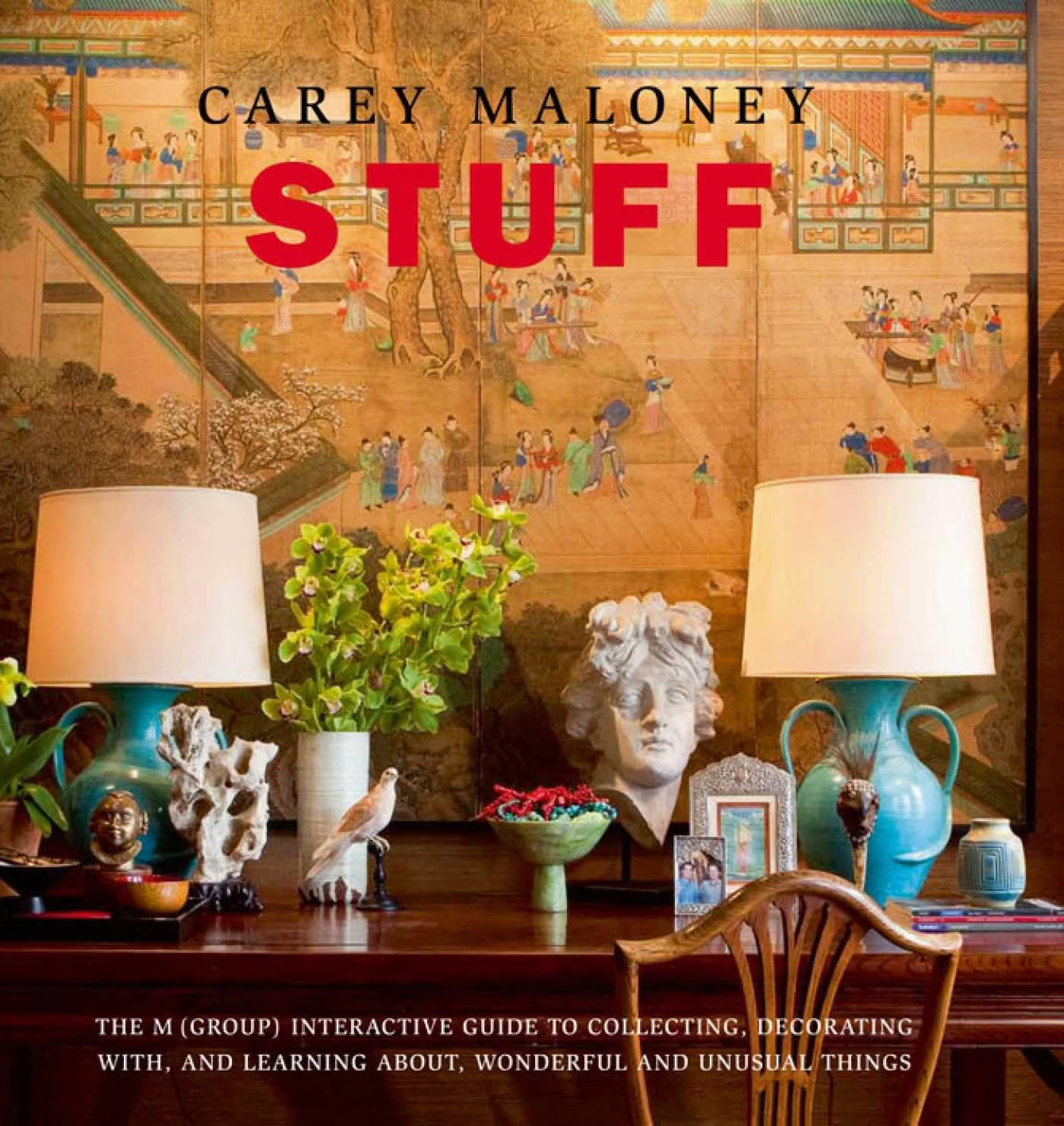
Stuff: The M(Group) Interactive Guide to Collecting, Decorating With, and Learning About, Wonderful and Unusual Things explores this relationship between collecting, interior design, art, and curiosity. Written by Carey Maloney, the book examines the objects and collections that contribute to the interiors created by M(Group), the architecture and interior-design firm founded by Maloney and architect Hermes Mallea. The firm was established in 1984 and has worked across architecture and interior design.
The book was published by Pointed Leaf Press and distributed by Simon & Schuster. The edition associated with ISBN-10 0983388989 and ISBN-13 9780983388982 is a hardcover publication from 2012/2013 depending on the cataloging source, with approximately 218–224 pages and hundreds of color photographs.
What makes Stuff particularly distinctive is its combination of interior photography, collecting ideas, historical information, and an interactive component. The publisher describes a digital-recognition system that allows readers to explore additional information connected to approximately 40 topics, including links to museums, dealers, shops, and research resources.
The subject matter is intentionally wide-ranging. Rather than limiting itself to conventional furniture or familiar decorative categories, the book explores objects and collections such as anatomical models, Australian Aboriginal art, pre-Columbian pottery, Coromandel screens, taxidermy, Tiffany lamps, and many other unusual subjects.
For readers interested in interior design, antiques, art collecting, decorative objects, architecture, or the history behind everyday things, this creates a different kind of design resource. It encourages the reader to look at interiors not simply as arrangements of furniture, but as environments shaped by curiosity, collecting, cultural references, personal history, and visual relationships.
Because the book was published more than a decade ago, its interactive technology should also be considered in its historical context. Digital recognition systems and linked online resources can change as apps, websites, operating systems, and online destinations evolve. The printed photography and design concepts, however, remain independent of those technological changes.
What Is Stuff: The M(Group) Interactive Guide?
Stuff is a large-format interior-design and collecting book by Carey Maloney. It focuses on the interiors created by M(Group), the design firm founded by Maloney and Hermes Mallea, while also exploring the objects that give those spaces their individual character.
The publisher describes the book as an interactive omnibus that takes readers into the homes of passionate collectors and examines the wide range of art, furniture, and objects used in M(Group)’s interiors.
Rather than presenting collecting as a purely financial activity, the book approaches objects through design, history, curiosity, and personal expression.
That distinction is important.
A collection does not necessarily have to consist of rare or expensive objects. Someone might collect ceramics, maps, vintage advertisements, scientific instruments, botanical prints, books, textiles, lamps, toys, or objects associated with a particular profession or period.
The book’s subject matter demonstrates how unusual objects can become part of an interior when they are placed thoughtfully.
The result is a combination of:
- Interior-design photography
- Collecting inspiration
- Art and decorative-object history
- Architectural context
- Cultural references
- Personal anecdotes
- Research resources
- Interactive digital material
The publisher identifies the book as a hardcover measuring approximately 11 by 12 inches, with 218 pages, while other bibliographic sources list 224 pages.
Key Features
A Focus on Collecting
Collecting is at the center of the book.
Rather than treating decorative objects as interchangeable accessories, Stuff explores how objects can carry meaning. A collection can reflect a person’s professional interests, travel experiences, historical curiosity, artistic preferences, or simply an attraction to unusual forms.
This creates an important connection between collecting and interior design.
A room does not have to be decorated exclusively with objects purchased at the same time or from the same design period. Different pieces can coexist when there is a meaningful relationship between them.
For example, an antique object might sit alongside contemporary furniture. A scientific model could become a visual counterpoint to traditional artwork. A collection of ceramics could introduce color and texture into a room with relatively simple architectural lines.
The book provides examples of this layered approach through the interiors and collections associated with M(Group).
Unusual and Unexpected Objects
The title’s emphasis on “wonderful and unusual things” is reflected in the subjects selected.
The book explores objects ranging from anatomical models to taxidermy and from pre-Columbian pottery to Tiffany lamps.
This range encourages readers to reconsider what qualifies as a decorative object.
Interior design is often associated with familiar categories such as sofas, tables, curtains, rugs, lighting, and artwork. Those elements remain important, but unusual objects can introduce another layer.
An object with an interesting history can become a conversation point. An unusual shape can provide visual contrast. A group of related objects can create rhythm across a room.
The underlying idea is that decoration can emerge from curiosity rather than from following a predetermined shopping list.
Interior Photography
The visual component is an important part of the book.
The publisher and booksellers describe the book as a large-format hardcover with extensive color photography. One bookseller specifies approximately 300 color photographs.
Photography allows readers to examine how objects function in actual interiors rather than seeing them only as isolated catalog items.
This distinction matters because an object can look very different depending on its surroundings.
A lamp may become a focal point against a plain wall. A collection of small objects may work better when grouped together than when distributed throughout a room. A large piece of artwork may need sufficient surrounding space to remain visually effective.
Photographs can communicate these relationships more effectively than a simple list of decorating rules.
The M(Group) Design Approach
The book is closely connected to M(Group), the design firm established by Carey Maloney and Hermes Mallea in 1984. The firm describes its work as architecture and interior design, with an international publication history.
The firm’s work provides the visual setting in which the objects are presented.
This makes the book different from a conventional antiques encyclopedia. It is not simply a catalog of objects with historical descriptions. Instead, objects are considered as components of designed spaces.
This approach can help readers think about scale, proportion, placement, contrast, repetition, color, and visual balance.
Interactive Digital Component
One of the more unusual aspects of the publication is its interactive component.
The publisher describes digital recognition technology that allows readers to access additional information associated with approximately 40 topics. The system was designed to connect readers with museums, dealers, shops, and research resources beyond the printed book.
This concept was particularly distinctive when the book was published.
The idea was to make the printed page a starting point rather than an endpoint. A reader could encounter an object or topic in the book and then explore related material digitally.
Because the book dates from the early 2010s, however, readers should not assume that every original digital link, app, or interactive feature remains functional today.
The printed content remains the more durable part of the experience.
Personal Anecdotes
The publisher describes the book as containing personal anecdotes from Carey Maloney alongside the visual and informational material.
Anecdotes can provide another way of understanding collecting.
Objects are not always selected through a purely analytical process. People often become interested in something because of where they encountered it, what it reminds them of, its unusual appearance, or the story associated with it.
These personal connections can become part of an interior’s identity.
Collecting as Part of Interior Design
Objects Can Tell Stories
One of the most useful ideas to take from a collecting-focused design book is that objects can communicate information.
A room containing carefully selected objects can tell visitors something about its occupants.
A collection of travel maps may suggest an interest in geography and exploration. Old scientific instruments may indicate fascination with science. Artifacts from different historical periods can create a visual conversation between cultures and eras.
This does not mean every object needs a profound story.
Sometimes the attraction is simply visual.
The important point is that personal objects can make a space feel connected to its occupants rather than assembled from a generic catalog.
Collections Create Relationships
A single object may be interesting, but several related objects can create a stronger visual statement.
Collections introduce repetition.
Repeated forms, colors, materials, periods, or themes can create cohesion even when individual objects differ.
For example, a group of ceramic vessels might vary in shape while sharing a material. A collection of maps might differ geographically while sharing a particular printing style. A series of lamps could vary in design while creating a recurring visual element.
This is one reason collections can become effective interior-design tools.
Mixing Periods and Styles
Traditional decorating often emphasizes consistency.
A room might be described as modern, traditional, industrial, minimalist, or eclectic.
In practice, many interesting interiors combine elements from multiple periods.
An antique chair can sit beside a contemporary table. Modern architecture can provide a setting for historical objects. A traditional painting can be displayed in a room with contemporary lighting.
The challenge is not necessarily to make everything match.
Instead, the designer can look for relationships in scale, color, material, shape, or visual rhythm.
The M(Group) approach presented through Stuff provides examples of interiors in which diverse objects contribute to a layered environment.
How It Can Be Used
As Interior-Design Inspiration
The most immediate use of Stuff is as a source of visual inspiration.
Readers can study photographs to see how furniture, art, architectural elements, and collections interact.
Rather than copying a room exactly, a reader can identify individual ideas that might translate to a different home.
For example:
- Grouping similar objects
- Using unusual objects as focal points
- Combining old and new pieces
- Creating visual contrast
- Using collections to fill architectural spaces
- Allowing objects to reflect personal interests
- Mixing materials and textures
The goal can be inspiration rather than imitation.
As a Starting Point for Collecting
Someone who has never collected decorative objects may not know where to begin.
A broad exploration of unusual objects can help identify subjects that genuinely interest the reader.
The process can begin with a question:
What kind of object would I enjoy learning about even if I never purchased it?
That question shifts collecting away from acquisition alone and toward curiosity.
Someone may discover an interest in vintage scientific equipment, antique maps, ceramics, botanical illustrations, lamps, textiles, or historical furniture.
Once an interest is identified, the collector can research the history, makers, materials, provenance, and preservation requirements associated with the category.
As a Research Companion
The book’s interactive concept was designed partly to connect readers with museums, dealers, and research resources.
This makes research an important part of the experience.
For valuable or historically significant objects, research can include:
- Identifying the maker
- Establishing approximate age
- Understanding materials
- Investigating provenance
- Comparing similar examples
- Consulting museum collections
- Reading specialist references
- Learning conservation requirements
Research can make collecting more meaningful even when no purchase is involved.
As a Coffee-Table Reference
The large format and extensive photography also make the book suitable for browsing.
A reader can open it without having a specific design problem to solve and simply explore the photographs, objects, and subjects.
This type of browsing can be valuable because design ideas often emerge indirectly.
A photograph may suggest a color combination. An unusual object may inspire a collecting idea. A particular arrangement may change how someone thinks about displaying books, artwork, or decorative pieces.
Who It May Be Suitable For
Interior Design Enthusiasts
Readers interested in residential interiors can explore how collections and unusual objects influence the character of a room.
Collectors
Collectors may appreciate the wide range of categories presented in the book and the emphasis on learning about objects rather than simply acquiring them.
Antiques Enthusiasts
The historical and object-focused approach can be relevant to people who enjoy antiques, decorative arts, and objects with cultural or historical associations.
Architecture Readers
Because M(Group)’s architecture and interior-design work provides the context for the book, architecture enthusiasts may find the relationship between structure and decoration interesting.
Art Lovers
The book includes art and decorative objects alongside furniture and architecture, making it relevant to readers interested in visual culture more broadly.
Students of Interior Design
Students can use the photographs as examples for thinking about composition, proportion, scale, layering, and the relationship between objects and rooms.
Curious Readers
The book is not limited to professional designers. Someone who enjoys learning about unusual historical objects may find its range of subjects appealing.
Important Things to Consider
It Is an Older Publication
The book dates from 2012/2013 depending on the edition or cataloging source. The publisher currently identifies the ISBN as 978-0-983388-98-2, while the Amazon-linked ISBN-10 is 0983388989.
The design photography and printed research remain useful, but some references may reflect the collecting and design landscape of the period when the book was produced.
The Interactive Technology May Have Limitations Today
The digital-recognition component was designed to connect physical pages with online information.
Modern readers should keep in mind that websites, mobile applications, domains, and digital services can change or disappear.
The interactive feature should therefore be viewed as an additional component rather than the sole reason to use the book.
Collecting Requires Research
An attractive object is not necessarily a valuable object.
The book can inspire curiosity, but readers interested in purchasing antiques or collectibles should conduct independent research.
Factors such as authenticity, condition, provenance, restoration, rarity, maker, cultural origin, and market demand can all affect an object’s significance.
Cultural Objects Require Context
Some categories discussed in the book involve objects originating from particular cultures or historical periods.
Collectors should approach such objects with appropriate attention to cultural context, provenance, legal restrictions, ethical considerations, and responsible sourcing.
This is especially relevant when dealing with archaeological artifacts, Indigenous cultural material, wildlife-related objects, or objects whose export or sale may be regulated.
Decorative Choices Are Personal
The interiors presented in the book reflect a particular design philosophy and the work of M(Group).
Readers do not need to reproduce that aesthetic exactly.
A useful design reference should provide ideas rather than dictate a single definition of good taste.
Comparison of General Categories
Interior-Design Book vs. Collecting Guide
A conventional interior-design book may focus primarily on rooms, furniture arrangements, color schemes, materials, and architectural elements.
A collecting guide tends to focus more heavily on individual objects, their history, identification, and acquisition.
Stuff occupies a middle ground.
It examines collections while showing how those objects function within complete interiors.
Coffee-Table Book vs. Practical Design Manual
A practical design manual usually provides structured instructions.
A large-format illustrated book may instead emphasize visual examples, inspiration, and exploration.
Stuff fits strongly into the latter category while still providing informational context around the objects it presents.
Museum Catalog vs. Decorative-Arts Book
A museum catalog generally focuses on institutional collections and scholarly documentation.
A decorative-arts book may be more concerned with how objects exist in private environments.
Stuff takes the latter approach by placing objects within homes and designed interiors.
Historical Reference vs. Current Buying Guide
The book can help readers understand objects and develop collecting interests.
It should not be treated as a current price guide or definitive source for contemporary market values.
Collectors should use current specialist resources when researching present-day prices, authenticity, market conditions, or legal requirements.
Building a Personal Collection
A collection does not need to begin with a large budget or a fully developed theme.
A useful starting point is observation.
Visit museums, galleries, antique stores, flea markets, design exhibitions, architectural spaces, and online archives. Pay attention to which objects repeatedly capture your attention.
Then begin researching.
Ask:
- What is this object?
- Who made it?
- When was it made?
- What was it originally used for?
- What materials were used?
- Where did it originate?
- How common is it?
- What condition should it be in?
- How should it be displayed?
- Does it require special conservation?
This process can transform collecting into an educational activity.
Choosing a Theme
Some collections develop around a clear theme.
Possible themes might include:
- A particular material
- A historical period
- A geographic region
- A profession
- A design movement
- A color
- A type of object
- A maker
- A particular function
A theme can make it easier to decide what belongs in a collection and what does not.
However, not every collection needs strict boundaries.
Some collectors simply follow curiosity.
Displaying Objects
Collecting and displaying are separate decisions.
An object may be valuable to the collector but not necessarily need to be displayed prominently.
When arranging objects, consider:
Scale: Large pieces need appropriate surroundings.
Spacing: Objects need enough visual room to remain distinguishable.
Grouping: Related pieces can create a stronger composition.
Lighting: Lighting can influence how materials, colors, and textures appear.
Safety: Fragile or valuable objects may require secure placement.
Context: The surrounding furniture and architecture affect how the object is perceived.
These principles apply whether the objects are valuable antiques or inexpensive personal finds.
Learning From Unusual Objects
One of the broader ideas behind Stuff is that objects can become gateways into other subjects.
A lamp can lead to an exploration of industrial design.
A map can introduce geography and printing history.
A ceramic vessel can lead to archaeology, craftsmanship, or cultural history.
An anatomical model can introduce medical education and scientific illustration.
A piece of furniture can lead to architecture, materials, manufacturing, and social history.
This is one reason collecting can be an intellectual activity as well as a decorative one.
The object becomes a starting point for research.
Using the Book for Interior Design Projects
A reader working on a room can use the book as a visual reference without copying its interiors directly.
Start with the architecture.
What are the room’s proportions, windows, doors, ceiling height, and natural-light conditions?
Then consider the major furniture.
After that, identify spaces where objects could provide personality.
Instead of filling every surface, select a few meaningful categories.
A small collection can be concentrated in one area, while a larger object can act as a focal point elsewhere.
This approach can help avoid an interior that feels either completely empty or visually overloaded.
The examples in Stuff demonstrate how collections can be incorporated into rooms as part of a broader design composition.
Frequently Asked Questions
Who wrote Stuff: The M(Group) Interactive Guide?
The book was written by Carey Maloney, founder of M(Group) with architect Hermes Mallea.
What is the ISBN of the book?
The edition is associated with ISBN-10 0983388989 and ISBN-13 9780983388982.
Who published the book?
The book was published by Pointed Leaf Press and distributed by Simon & Schuster.
What kind of book is Stuff?
It is a large-format illustrated book combining interior design, architecture, collecting, art, decorative objects, historical information, and personal anecdotes.
How many pages does it have?
Publisher information describes the hardcover as 218 pages, while other bibliographic and retail sources list 224 pages.
Is Stuff a book about interior design?
Interior design is a major part of the book, but its scope is broader. It explores the relationship between interiors and collections of art, furniture, and unusual objects.
What kinds of objects are discussed?
The book covers a wide variety of subjects, including anatomical models, Australian Aboriginal art, pre-Columbian pottery, Coromandel screens, taxidermy, Tiffany lamps, and other unusual objects.
Does the book include photographs?
Yes. It is heavily illustrated with color photography. One bookseller describes approximately 300 color photographs.
What is the interactive component?
The book was designed with digital-recognition technology that could connect certain printed topics with additional online resources, including museums, dealers, shops, and research sources.
Does the interactive feature still work today?
The original digital system may not function exactly as it did when the book was published. Online services, websites, and applications can change over time.
The printed book can still be used independently of those digital components.
Is this a guide for professional collectors?
It can provide inspiration and research ideas, but it should not be treated as a comprehensive professional appraisal, authentication, or valuation manual.
Collectors dealing with significant purchases should conduct independent research and consult appropriate specialists.
Is it useful for someone who is new to collecting?
It can provide a broad introduction to different types of objects and demonstrate how collections can become part of an interior.
A beginner can use the book to discover categories of objects that interest them before developing a more focused collecting strategy.
Does the book provide current market prices?
It is not a current price guide. Market values can change considerably, and contemporary valuation requires current specialist information.
Is the book only for wealthy collectors?
The concepts presented do not require someone to own rare or expensive objects. Collecting can involve inexpensive objects, found items, books, prints, ceramics, or other things connected to a person’s interests.
Can the book help with decorating a home?
It can provide visual inspiration for arranging collections, artwork, furniture, and unusual objects within interiors.
Is the book suitable for interior-design students?
It can serve as a visual reference for studying how objects interact with architecture, furniture, scale, color, and composition.
Who is M(Group)?
M(Group) is an architecture and interior-design firm founded by Carey Maloney and architect Hermes Mallea in 1984. The firm describes its work as architecture and interior design and has been published internationally.
Is the book about antiques only?
No. The subject matter extends beyond conventional antiques to art, furniture, scientific objects, cultural artifacts, decorative pieces, and unusual items.
Can the book be used as a source for cultural research?
It can serve as an introduction to various objects and subjects, but readers interested in detailed cultural, historical, archaeological, or anthropological research should consult specialist academic and institutional sources.
Why might unusual objects be useful in interior design?
Unusual objects can introduce contrast, conversation, historical context, visual interest, and personal character into a room.
Their value in an interior does not necessarily depend on monetary value.
Conclusion
Stuff: The M(Group) Interactive Guide to Collecting, Decorating With, and Learning About, Wonderful and Unusual Things explores the relationship between objects, collections, architecture, and personal interiors.
Written by Carey Maloney and published by Pointed Leaf Press, the book presents the work and collecting interests associated with M(Group), the architecture and interior-design firm Maloney founded with Hermes Mallea in 1984.
Its appeal comes from the breadth of its subject matter. Instead of concentrating only on conventional furniture and decoration, the book moves into unusual territory, including anatomical models, Aboriginal art, pre-Columbian pottery, Coromandel screens, taxidermy, Tiffany lamps, and many other categories of objects.
The book also demonstrates how collecting can become part of interior design. Objects can provide more than decoration: they can communicate interests, preserve memories, introduce historical context, create visual contrast, and give rooms a sense of individuality.
The interactive component adds another dimension by connecting selected printed topics with digital research resources. Because the publication dates from the early 2010s, however, readers should treat the original digital system as a historical feature that may not function exactly as it did when first released.
Perhaps the broader lesson is that decorating does not have to begin with a predetermined style. A home can develop through curiosity. A person can discover an object, research its history, appreciate its form, and eventually find a place for it within a larger environment.
For readers interested in interior design, collecting, art, architecture, antiques, or unusual historical objects, Stuff provides a visual and informational exploration of how these subjects can overlap. It can be approached as a source of decorating ideas, a collecting reference, a large-format visual book, or simply an invitation to learn more about the objects that surround us.
Leave a Reply