Introduction
Creating a successful video game involves considerably more than coming up with an interesting idea. A game has to be designed around rules, player interaction, goals, challenges, feedback, pacing, content, technology, production constraints, and a clearly defined audience. Behind the finished product is also a large business process involving development teams, publishers, testing, marketing, distribution, licensing, and sales.
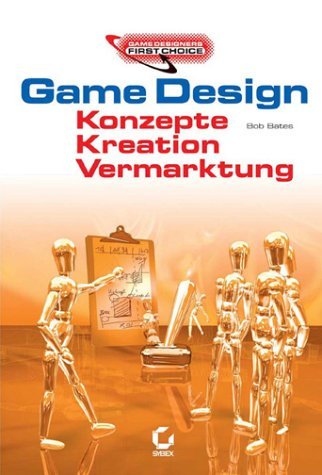
Game Design: Konzepte, Kreation, Vermarktung by Bob Bates approaches game development from this broader perspective. The German edition was published by SYBEX Verlag in 2002 and is associated with ISBN-10 3815504333 and ISBN-13 9783815504338. Bibliographic listings identify the edition as a German-language hardcover with 312 pages.
The original English work is known as The Art & Business of Creating Games, a title that helps explain the scope of the book. Rather than concentrating exclusively on the mechanics of game design, it discusses the process of taking a game from an initial concept through development and toward the commercial marketplace.
That distinction is useful for anyone interested in game development. A designer may understand gameplay systems but still need to work with producers, programmers, artists, testers, publishers, marketers, and other specialists. A technically impressive game can also face practical challenges if its scope is unrealistic, its audience is poorly understood, or its commercial strategy is not considered early enough.
The book therefore provides a broader look at game creation. It addresses the creative side of developing games while also introducing the production and business structures surrounding the industry.
Its historical context should also be kept in mind. The German edition dates from 2002, a period when the games industry looked substantially different from today’s market. Digital distribution, mobile games, free-to-play services, live-service products, independent publishing platforms, modern game engines, virtual reality ecosystems, and many current monetization models either did not exist in their present forms or were not yet central to the industry.
Consequently, the book is most useful as a foundational resource about game-development thinking, production, roles, design documentation, and the relationship between creative work and business. Current developers should supplement those concepts with contemporary information about technology, platforms, publishing, marketing, monetization, and distribution.
What Is Game Design: Konzepte, Kreation, Vermarktung?
Game Design: Konzepte, Kreation, Vermarktung is the German-language edition of Bob Bates’ work on the art and business of creating games.
Bob Bates began his game-writing career at Infocom in 1985 and subsequently worked as a writer, designer, and producer on numerous games. His career included work on titles such as Eric the Unready, and published biographical material describes involvement with more than 25 games.
The German edition was published by SYBEX Verlag in 2002. Bibliographic sources identify the ISBN as 3815504333, with ISBN-13 9783815504338, and describe a 312-page German hardcover edition.
The book’s subject can be divided into several connected areas:
- Game concepts and design
- Game genres and player experiences
- The creative development process
- Game-development roles
- Production workflows
- Game design documentation
- Testing and quality assurance
- Working with publishers
- Licensing and contracts
- Presenting games to potential partners
- Marketing and sales
- The commercial structure of the games industry
This broad scope is important. Game development is a multidisciplinary process, and the designer’s responsibilities do not exist independently from the rest of the team.
Key Features and Learning Areas
Understanding Game Design as a Process
A game idea is only the beginning.
Suppose someone has an idea for an adventure game involving exploration, puzzles, characters, and a fictional world. That concept still needs answers to numerous questions.
What does the player actually do?
How does the player make progress?
What creates challenge?
What happens when the player fails?
How are objectives communicated?
How long is the experience intended to last?
What technology is required?
Who is the intended audience?
How large is the development team?
How much content is realistic to produce?
These questions turn an abstract idea into a design problem.
The book approaches game design within this larger production context. This is one reason its material can be relevant to people who want to understand not only how games are designed but also how game projects move through the industry.
From Idea to Finished Game
One of the central themes of professional game development is the transformation of an idea into a product.
The process generally involves multiple stages, although the exact structure varies between studios and projects.
A simplified development cycle might include:
- Initial concept
- Concept development
- Prototype or proof of concept
- Pre-production
- Production
- Testing
- Refinement
- Release preparation
- Marketing and distribution
- Post-release support
The boundaries between these stages are not always rigid.
Designers may revise systems during production. Testers may identify problems that require changes to the design. Marketing considerations may affect positioning. Technical limitations may force a feature to be redesigned.
Thinking about development as an interconnected process helps explain why game design is rarely a purely isolated creative activity.
Game Design Documents
Documentation is an important part of professional game development.
A game design document, commonly called a GDD, can provide a structured description of a game’s intended mechanics, systems, features, content, rules, and player experience.
Educational programs have also treated the creation and maintenance of a Game Design Document as a core part of game-development education, alongside understanding genres, industry roles, game engines, and programming fundamentals.
A design document can help communicate ideas between different specialists.
For example, a programmer may need to understand how a gameplay system should behave. An artist may need information about the intended visual direction. A level designer may need rules governing progression. A producer may need to understand the scope of planned features.
The document does not eliminate communication, but it can provide a common reference point.
Game Genres
Understanding genres helps designers identify established player expectations.
Adventure games, strategy games, role-playing games, simulation games, action games, puzzle games, sports games, and other categories each have conventions.
A designer does not have to follow every convention, but understanding them can help clarify what the player is likely to expect.
Genre also affects marketing. A potential player often needs to understand the type of experience a game offers before deciding whether it interests them.
Player Types and Audience
A game is designed for people, not simply for a technical specification.
Different players can have different motivations, preferences, levels of experience, and expectations.
Some players may enjoy competition. Others may prefer exploration, storytelling, strategy, experimentation, creativity, or social interaction.
Understanding the intended audience can influence difficulty, controls, pacing, visual presentation, tutorials, progression systems, and marketing communication.
Audience definition also helps prevent a common design problem: trying to make a game appeal equally to everyone.
A clear audience does not guarantee commercial success, but it provides a more concrete foundation for design decisions.
Team Roles
Game development involves many specialized roles.
Depending on the project, a team can include:
- Game designers
- Programmers
- Artists
- Animators
- Writers
- Audio designers
- Producers
- Quality-assurance testers
- User researchers
- Marketing professionals
- Community specialists
- Business-development staff
The exact structure depends on the studio and project.
One of the useful perspectives in a broad game-development guide is understanding how these roles interact.
A designer may define a gameplay system, but programmers determine how it can be implemented. Artists create the visual assets, while producers coordinate schedules and resources. Testers identify problems, while marketing teams communicate the product to its intended audience.
The finished game is therefore the result of coordinated work rather than a single person’s creative output.
Production and Scheduling
Creative projects still have deadlines, budgets, dependencies, and resource limitations.
A designer may propose an ambitious feature, but the production team has to consider whether the required programming, art, animation, audio, testing, and content can be completed within the available resources.
This creates a fundamental tension in game development: ambition versus feasibility.
Production planning helps transform that tension into decisions.
A feature may be retained, simplified, postponed, or removed depending on its value and cost.
Understanding this process is particularly important for independent developers, who often have to make these tradeoffs with very limited resources.
Game Design Concepts in Practice
Mechanics
Game mechanics are the rules and systems through which players interact with the game.
Examples include:
- Movement
- Combat
- Resource management
- Crafting
- Trading
- Puzzle solving
- Character progression
- Building
- Exploration
A mechanic should have a purpose within the larger experience.
Adding a mechanic simply because it appears interesting can create complexity without improving the game.
A well-defined design process asks how each mechanic contributes to the intended player experience.
Goals and Challenges
Games usually provide some form of objective or challenge.
The goal may be explicit, such as completing a mission, or more open-ended, such as building an efficient virtual city.
Challenges create the problems that players must solve.
Good design requires a relationship between challenge and player ability. If the game is too easy, some players may lose interest. If it is excessively difficult or poorly explained, players may become frustrated.
The appropriate balance depends heavily on the genre and intended audience.
Feedback
Players need information about what their actions accomplish.
Feedback can be visual, audio, textual, physical, or systemic.
A sound may confirm that an action succeeded. A visual effect may communicate damage. A score may show progress. A character animation may indicate an interaction.
Feedback helps players build a mental model of the game’s rules.
Without clear feedback, even a well-designed mechanic can feel confusing.
Progression
Progression gives players a reason to continue.
A game might use:
- New abilities
- New levels
- Increasing difficulty
- New environments
- Story developments
- Character growth
- Equipment
- Unlockable content
Progression should support the game’s overall structure rather than simply adding rewards.
The designer must consider what the player learns, how the difficulty changes, and why continued play remains meaningful.
Narrative and Story
Not every game requires a complex narrative, but many games use storytelling as part of the player experience.
Narrative can be delivered through dialogue, environments, characters, cinematics, objects, gameplay events, or combinations of these methods.
Interactive storytelling creates a special challenge because the player is not merely watching events. The player is participating in a system.
This means narrative design and gameplay design may need to work together rather than operating as completely separate components.
How the Book Can Be Used
As an Introduction to the Games Industry
Someone interested in entering the games industry may initially know only the creative side of game development.
A broader industry guide can help explain the other components involved.
Understanding the roles of producers, publishers, marketers, testers, and business-development professionals can provide a more realistic picture of how commercial games are created.
As a Starting Point for a Game Design Project
A person with a game idea can use the concepts discussed in the book to begin organizing that idea.
Instead of simply writing a paragraph describing the game, the creator can begin documenting:
- Target audience
- Genre
- Core gameplay loop
- Main mechanics
- Player objectives
- Progression
- Story
- Art direction
- Audio direction
- Platform
- Development requirements
- Production scope
- Testing requirements
- Distribution strategy
This creates a more structured starting point.
As Background for Game Design Students
Academic game-development programs commonly teach students about game genres, industry structures, game-design documents, game engines, and development processes. University course documentation has included Bob Bates’ book among recommended literature for digital-game modules.
Students can therefore use the book as historical and professional context alongside practical development exercises.
As a Reference for Independent Developers
Independent developers frequently have to perform several roles themselves.
A small team might have only one designer, one programmer, and one artist. In some projects, one person may perform all three roles.
Understanding production, documentation, testing, marketing, and business considerations can help an independent developer think beyond the prototype.
As a Historical Perspective
Because the book dates from the early 2000s, it can also be viewed as a snapshot of the games industry during an earlier era.
This can be useful for understanding how traditional development and publishing operated before digital distribution and today’s ecosystem of mobile stores, PC storefronts, live-service platforms, and social communities became dominant.
Who It May Be Suitable For
Aspiring Game Designers
Someone considering game design as a career may find value in understanding the profession beyond the title itself.
Game design includes creative decisions, communication, documentation, iteration, testing, and collaboration.
Game Development Students
Students can use the book as supplementary reading alongside practical assignments involving prototypes, design documents, engines, and programming.
Independent Developers
Indie developers often need to understand the full development pipeline rather than focusing on a single specialist role.
Producers and Project Coordinators
People involved in production may benefit from understanding how design decisions affect other departments.
Writers and Narrative Designers
Writers working in games need to understand how story interacts with gameplay, player agency, pacing, and production.
Entrepreneurs and Small Studios
People planning to establish an independent game studio may find the discussion of business and commercial processes useful as background.
Game Industry Enthusiasts
Readers who want to understand what happens behind a finished game can use the book to explore the different stages and roles involved in development.
Important Things to Consider
The Book Is More Than a Modern Design Manual
The title emphasizes game design, creation, and marketing, but the book’s scope is broader than gameplay mechanics alone.
The original English work is described as covering the process of creating games as well as the business surrounding the industry.
Readers expecting a highly specialized manual dedicated solely to modern gameplay theory should keep that distinction in mind.
It Is an Older Book
The 2002 German edition is more than two decades old.
This matters considerably for technical subjects.
Modern game engines, hardware, distribution platforms, monetization systems, development pipelines, analytics tools, online infrastructure, and marketing channels have changed significantly.
The underlying concepts of design, production, communication, and player experience can remain useful, but specific technology and industry practices should be researched using current sources.
The Games Business Has Changed
In the early 2000s, boxed retail distribution and publisher relationships played a much larger role in the commercial path of many games.
Today’s developers may use digital storefronts, early access, crowdfunding, self-publishing, subscription services, direct-to-consumer communities, social media, and other channels.
The business principles discussed in the book can still provide context, but modern developers need to understand today’s commercial environment separately.
Marketing Is Not Simply Advertising
Marketing a game involves understanding its audience, positioning, communication, timing, distribution, community, and overall market context.
A good marketing strategy cannot compensate for every weakness in a game’s design, nor can strong design automatically guarantee commercial performance.
The relationship between product and market is more complicated than simply creating a game and promoting it.
Scope Can Become a Major Risk
A common challenge for new developers is choosing a project that is too large for their resources.
An ambitious open-world game, for example, may require extensive programming, art, animation, writing, audio, level design, testing, infrastructure, and production management.
A smaller project can provide an opportunity to learn the full development cycle without requiring the same scale of resources.
This is particularly relevant to beginners.
Comparing General Categories of Game-Development Books
Game Design Theory vs. Industry Guide
A game-design theory book may focus heavily on mechanics, player psychology, systems, rules, balance, and interaction.
An industry-oriented guide covers a broader range of subjects, including production and business.
Game Design: Konzepte, Kreation, Vermarktung belongs to the broader category.
Game Design Book vs. Programming Manual
A programming manual teaches implementation skills such as scripting, algorithms, programming languages, or engine-specific development.
A game-design book focuses on what the game should do and how the player experience is structured.
Both skill sets can be valuable, but they answer different questions.
Historical Industry Guide vs. Current Development Manual
An older industry guide can explain foundational workflows and provide insight into how the industry operated during its publication period.
A modern manual is more appropriate for current engine features, platform requirements, distribution processes, and contemporary production tools.
Using both can provide historical context while avoiding reliance on outdated technical instructions.
Broad Game-Creation Guide vs. Specialized Design Text
A broad guide introduces many disciplines.
A specialized book may spend hundreds of pages on one subject such as level design, narrative design, multiplayer systems, monetization, user experience, or game economy design.
The right category depends on the reader’s learning objective.
Practical Game Design Workflow
A practical way to apply the ideas behind a broad game-design guide is to start with a small concept.
Begin by writing a one-sentence description of the game.
Then identify the intended player.
Next, describe the core activity. What does the player repeatedly do?
That repeated activity becomes the foundation for the core gameplay loop.
After that, define the major rules.
What can the player do?
What can the player not do?
What causes success?
What causes failure?
How does the game respond?
Once those questions are answered, create a simple prototype.
The prototype does not need polished graphics. Its purpose is to test whether the central interaction is actually interesting.
This is where iteration becomes important.
A designer may discover that an idea that sounded exciting on paper does not work well when played. Alternatively, a simple mechanic may become more interesting when tested.
Prototyping therefore turns assumptions into observations.
Building a Game Design Document
A basic GDD can contain sections such as:
Game Overview
A short explanation of the concept and intended experience.
Target Audience
The type of player the game is designed for.
Genre
The primary category and relevant subgenres.
Core Gameplay
The main actions the player repeatedly performs.
Game Mechanics
The rules and systems governing interaction.
Progression
How the player’s experience changes over time.
World and Story
The setting, characters, narrative structure, and relevant lore.
Visual Direction
The intended visual style and presentation.
Audio
Music, sound effects, dialogue, and other audio requirements.
Technical Requirements
The platforms, engine requirements, online features, and other technical considerations.
Production Scope
The estimated content, team requirements, and development constraints.
Testing Plan
How the game will be evaluated and refined.
A GDD should be treated as a living document rather than an unchangeable contract. Development discoveries may require the design to evolve.
Testing and Iteration
Testing is one of the most important parts of game development.
A developer may understand the intended rules perfectly, while a new player may misunderstand them immediately.
This difference is valuable information.
Playtesting can reveal:
- Confusing controls
- Poor tutorials
- Difficulty spikes
- Unclear objectives
- Uninteresting mechanics
- Technical problems
- Pacing issues
- Balance problems
- Interface problems
The objective is not to make every player experience identical reactions. Instead, testing provides evidence that can inform design decisions.
Iteration then turns that evidence into changes.
This cycle can continue throughout development.
Marketing and Commercial Considerations
The title’s inclusion of “Vermarktung,” or marketing, is significant because commercial game development does not end when the software is technically complete.
A game needs to reach its intended audience.
Marketing can involve:
- Audience research
- Positioning
- Branding
- Trailers
- Screenshots
- Store descriptions
- Press communication
- Community development
- Events
- Influencer outreach
- Social media
- Launch planning
The specific methods available to a developer depend heavily on the platform and market.
An independent developer may handle much of this internally, while a larger publisher may have dedicated marketing and public-relations teams.
The core lesson is that marketing should be connected to the game’s actual identity. Promotional communication works best when it clearly explains what kind of experience the game offers.
Frequently Asked Questions
Who wrote Game Design: Konzepte, Kreation, Vermarktung?
The book was written by Bob Bates. The German edition was published by SYBEX Verlag.
What is the ISBN?
The German edition is associated with ISBN-10 3815504333 and ISBN-13 9783815504338.
When was the German edition published?
The German SYBEX edition was published in 2002.
How many pages does the German edition contain?
Bibliographic listings describe the German hardcover edition as having 312 pages.
What is the original English title?
The original English work is known as The Art & Business of Creating Games.
Is the book only about game mechanics?
No. Its scope extends into game creation, development roles, production, testing, publishing, marketing, licensing, contracts, and the broader games business.
Does it discuss game design documents?
The book is associated with detailed discussion of game design documentation. Independent educational references have also listed Bob Bates’ book as recommended literature for courses covering the structure and importance of Game Design Documents.
Is the book useful for beginners?
It can serve as an introductory resource because it provides a broad overview of the game-development industry and the different roles and stages involved in creating games. It should not, however, be treated as a complete modern training program for every game-development discipline.
Is it suitable for someone who wants to become a game designer?
It can provide useful background on the profession and development process. Someone pursuing a career in game design would generally benefit from combining such reading with practical prototyping, game-design exercises, documentation, playtesting, and familiarity with contemporary development tools.
Does the book teach programming?
Its primary subject is game design and the broader process of creating and commercializing games rather than serving as a programming-language textbook.
A developer who wants to learn programming would need additional resources focused on a language or game engine.
Does it cover game marketing?
Yes. Marketing and the business side of creating games are part of the book’s scope, reflected directly in the German title’s reference to “Vermarktung.” The original English work is similarly described as covering the business of creating games.
Is the book still relevant today?
Its foundational ideas about game design, production, teamwork, documentation, testing, and the relationship between development and business can still be useful.
However, the 2002 edition should not be relied upon for current technical instructions, platform policies, modern publishing systems, or contemporary marketing practices.
Why might an older game-development book still be useful?
Fundamental creative and production principles do not necessarily become obsolete as quickly as software tools.
Concepts such as defining a player experience, documenting mechanics, managing scope, testing ideas, communicating with a development team, and understanding the commercial context of a game can remain relevant.
Can the book help with an indie game project?
It can provide broader context for the stages involved in creating and commercializing a game. Independent developers should supplement that knowledge with current information about engines, platforms, publishing requirements, digital storefronts, marketing channels, and legal considerations.
Does a game designer work alone?
Not usually on larger commercial projects. Game development commonly involves multiple specialized roles, including programming, art, design, production, testing, audio, writing, and business or marketing functions.
Small independent projects can combine several roles in one person or a small team.
What is a Game Design Document?
A Game Design Document is a structured document describing important aspects of a game’s design, such as its mechanics, systems, rules, content, progression, and intended player experience.
Its exact structure varies between teams.
Why is prototyping important?
A prototype allows designers to test an idea before investing heavily in polished content.
It can reveal whether the core interaction works and can help identify design problems early.
Does marketing begin only after development is complete?
Not necessarily. Commercial positioning, audience understanding, branding, and communication can influence decisions throughout development.
The exact timing depends on the project, studio, publisher, and platform.
Conclusion
Game Design: Konzepte, Kreation, Vermarktung by Bob Bates offers a broad perspective on game development by connecting creative design with production and the business realities surrounding commercial games.
The German edition was published by SYBEX Verlag in 2002 and is identified by ISBN-10 3815504333 and ISBN-13 9783815504338. The edition is listed as a 312-page German-language hardcover.
One of the most useful ways to understand the book is to see it as a guide to the larger game-development process rather than as a narrowly focused manual on gameplay mechanics. Its subject matter encompasses concepts, creation, production, testing, industry roles, publishing, marketing, and other elements involved in turning a game idea into a commercial product.
That broad perspective can be useful for aspiring designers, students, independent developers, producers, writers, and people who simply want to understand how the games industry operates.
At the same time, the publication date matters. Game development has changed substantially since 2002. Modern engines, digital distribution, mobile platforms, online services, live operations, community platforms, analytics, virtual economies, and contemporary marketing channels require knowledge that an older book cannot provide in current detail.
The most practical approach is therefore to use the book for foundational concepts and historical industry context while supplementing it with current technical and commercial information.
For someone developing a game, the broader lesson is that successful development requires more than a creative idea. Designers need to think about players, mechanics, documentation, teamwork, production scope, testing, communication, and the market in which the finished game will exist.
Leave a Reply